

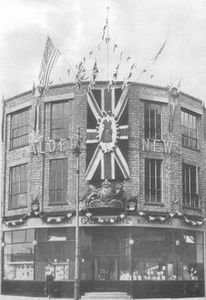
Gale and Polden Ltd
The firm of Gale and Polden was founded near Brompton Barracks at Chatham, James Gale opening his bookshop there at No 1 High Street, Old Brompton in 1868. Soon Gale acquired his first printing press, which he set up in a wooden shed in the garden at the rear of his house. Through his contacts with the Headquarters of the Chatham Military District, Gale obtained a printing contract for the printing of the Garrison Directory. In 1873 Gale printed and published his first book, Campaign of 1870–1: The Operations of the Corps of General V. Werder by Ludwig Lohlein, late Captain 1st Baden Bodyguard Grenadier Regiment. At this time Gale's printing works had three hand presses and only enough metal type to print sixteen pages at a time. Gale's staff was made up of three compositors, a bookbinder, a die stamper and three boys. His wife managed the shop's book and stationery sales, assisted by one of the boys. Composing department at Gale and Polden's Wellington Works in Aldershot c.1915 On 29 September 1875 James Gale took on his first apprentice, William T Nash, aged fourteen. Nash went on to work for the Company for sixty-eight years, rising to be Composing Room Overseer, a post he held for nearly forty years until 1943 when he died aged 82. In 1875 Nash was soon joined by Thomas Ernest Polden, aged 16. By 1880 the bookselling side of Gale's business was very successful, and Gale publicised it by announcing that "A selection of several hundreds of most modern and popular books will always be found in stock and, having made arrangements for receiving parcels from the principal London Houses daily, the book that should not happen to be in stock could be obtained immediately". Many of these developments were due to T. Ernest Polden, who had progressed from serving in the bookshop into working in the printing works where he gained an extensive knowledge of different printing processes. Polden went out from Chatham to the garrisons or dockyards at Gravesend, Dover, Canterbury and further afield, publicising the name Gale and Polden to the British Army and Navy. At that time most official military forms were written out in longhand by orderlies, and Polden saw an opportunity to extend the firm's business by printing standardised forms. His scheme resulted in large orders for the forms being placed. Polden, by now the senior partner in the business, decided to establish a London Office. "A Company of our standing and associations", he declared "must have its centre in the hub of the Empire!" The business had increased to such an extent that James Gale and T. Ernest Polden were considering forming Gale & Polden into a limited liability Company registered in London. At that time Fleet Street, St. Paul's Churchyard and Paternoster Row were the centre of publishing in London, and it was here that T. Ernest Polden looked for an office for the growing company. In 1892 he found suitable premises at No. 2, Amen Corner. At first the company had two rooms on the third floor, but this soon increased to four and gradually they took over the entire building. By this time the company were supplying printed forms and other stationery to about 400 military canteens, 100 officers' messes, 200 sergeants' messes, and 250 libraries, recreation rooms and regimental institutes throughout both the Army and Navy. The well-known Gale & Polden Military Series and other educational works were in use by Military Educational Department and by the London and other school boards, and in the colonial forces. On 10 November 1892 the company was incorporated as Gale & Polden Ltd, with a share capital of £30,000 in £5 shares. Unusually, the shares were offered to ordinary soldiers. In 1916 Gale & Polden were granted a Royal Warrant for producing Queen Mary's Christmas card. In 1918 a fire at the firm's Wellington Works destroyed one of the building's four wings, which temporarily halted printing. As a result of the fire, the company decided to maintain its own volunteer fire crew at the Works. In 1956 Gale & Polden acquired a number of smaller printing firms including Know Publications, producers of the Woking Opinion newspaper; Paines of Worthing and John Drew Ltd, an Aldershot-based rival. In 1963 Gale & Polden was taken over by the Purnell Group, and in 1964 Purnells merged with another printing company, Hazel Sun, to form the new British Printing Corporation (BPC), the largest printing company in Europe.[2] In 1916 Gale & Polden were granted a Royal Warrant for producing Queen Mary's Christmas card. In 1918 a fire at the firm's Wellington Works destroyed one of the building's four wings, which temporarily halted printing. As a result of the fire, the company decided to maintain its own volunteer fire crew at the Works. In 1956 Gale & Polden acquired a number of smaller printing firms including Know Publications, producers of the Woking Opinion newspaper; Paines of Worthing and John Drew Ltd, an Aldershot-based rival. In 1963 Gale & Polden was taken over by the Purnell Group, and in 1964 Purnells merged with another printing company, Hazel Sun, to form the new British Printing Corporation (BPC), the largest printing company in Europe.[2] In 1916 Gale & Polden were granted a Royal Warrant for producing Queen Mary's Christmas card. In 1918 a fire at the firm's Wellington Works destroyed one of the building's four wings, which temporarily halted printing. As a result of the fire, the company decided to maintain its own volunteer fire crew at the Works. In 1956 Gale & Polden acquired a number of smaller printing firms including Know Publications, producers of the Woking Opinion newspaper; Paines of Worthing and John Drew Ltd, an Aldershot-based rival. In 1963 Gale & Polden was taken over by the Purnell Group, and in 1964 Purnells merged with another printing company, Hazel Sun, to form the new British Printing Corporation (BPC), the largest printing company in Europe.
Printed by 1
 | Coronation and Commemorative Medals 1887 - 1953 | Paperback |