

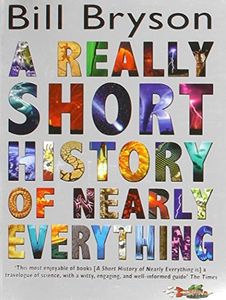
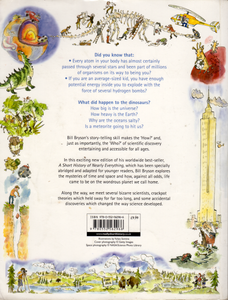
A Really Short History of Nearly Everything
| Book | A Really Short History of Nearly Everything |
| Format | Soft cover |
| Language | English |
| Copyright | 2003 |
| Author | Bill Bryson |
| Publisher | Random House Children's Books |
| Imprint | Corgi Books |
| First Published by | Doubleday |
| Foreword by | Bill Bryson |
| Cover photo | Getty Images |
| Illustrator | Yuliya Somina, Martin Sanders |
| Abridged by | Felicia Law |
| Editor | Felicia Law |
| Designed by | Simon Webb, Margaret Hope |
| Consultant | Sarah Chant, Martin Weaver |
| Copyright Holder | Bill Bryson, Getty Images, Science Photo Library |
| Format | Soft cover |
| Language | English |
| Location | Great Britain |
| Copyright | 2003 |
| Revised Edition | 2008 |
| Copyright | 2008 |
| This Edition Published | 2010 |
| Pages / Font | 169 pages / ARTotis Sans Serif |
| Barcode | 9 780552 562966 |
| ISBN | 978-0-552-56296-6 |
| Price | £9.99 |
| Chapters | CONTENTS
Foreword
LOST IN THE COSMOS
How do they know that? - finding out about our planet
Cooking up a universe - recipe for an explosion
The Big Bang - what came next
Hi! Glad you could make it! - how did you get here?
Listening to the Big Bang - cosmic radiation and you
To the edge of the universe - how far is it?
Journey into space - our vast solar system
Looking for Pluto - the new dwarf planet
Journey's end - the Voyager expeditions
Who's out there? - advanced life elsewhere in the cosmos?
The supernova searcher - the amazing Reverend Bob Evans
THE SIZE OF THE EARTH
Back on Earth - Newton and gravity
Measuring the Earth - finding the circumference
Earth's bulge - our planet is not a sphere
How far around? - two ill-fated measuring expeditions
Tracking Venus - following the Venus transit
Weighing the Earth - gravity and Shiehallion
Featherweight measures - Cavendish's calculations
Finding Earth's age - the new science of geology
The stone-breakers - the Geological Society
Slow and steady does it - Lyell and tectonic plates
Finding fossils - mapping Britain's rock layers
Dating the rocks - the great eras of geological time
Tooth and claw - digging up strange bones
Dinosaur hunters - 'terrible lizards'
It's bone time - bones and Earth's age
The mighty atom - Dalton weighs atoms
A matter of chemistry - adding the elements
The Periodic Table - Mendeleyev instils some order
Glowing elements - Marie Curie and deadly radiation
A NEW AGE DAWNS
Einstein - the genius - the Special Theory of Relativity
Spacetime - time has a shape
The big picture - the Hubble Space Telescope
'Bad' science - lead and CFCs
A meteoric age - measuring meteorites
DANGEROUS PLANET
Travelling trilobites - Pangaea and the fossil record
Crust crunching - the discovery of tectonic activity
All adrift - where does all the sediment go?
The fire below - the Earth beneath our feet
Boom! the eruption of Mount St Helens
Yellowstone Park - a volcano in waiting
Big quakes - measuring earthquakes
Impact from space - meteors and the KT extinction
Asteroid hit - rocky objects heading for us?
LIFE ITSELF
Our tiny patch - a comfortable place to be
Earth's blanket - the atmosphere that protects us
Wild and windy - Earth's weather
Hot-water bottle - the effect of the oceans
Awash with water - a watery planet
Down in the deep - living on the ocean floor
Protein soup - oceans - where life started
Battling bacteria - the coming of microbes
Your mini world - the bacteria that feed on us
Making you ill - infectious organisms
Citizen cells - you and your cells
How long can you stay? - adapt or die
A runaway success - trilobites and other fossils
Time to get started - Earth's long pre-human history
Out of the sea - where creatures took to the land
Where did we come from? - from reptiles to mammals
Comings and goings - the great extinctions
Labelling life - the classification of plants and animals
Can't count? - Earth's unknown creatures
Journey to the future - Darwin and On the Origin of Species
The quiet monk - Mendel and the study of genes
One big happy family - inheritance and chromosomes
Chain of life - Crick and Watson and DNA
THE ROAD TO US
Hot and cold - ice sheets and climate
Chilly times - living in an ice age
Skull and bones - discovering early human remains
Lucy - the most famous australopithecine
From there to here - the rise of Homo sapiens
Tool-makers - inventors of the first technology
Humans take over - extermination and extinction
What now? - a polluted planet
Goodbye - our planet and us
Index
Picture credits CONTENTS
Foreword
LOST IN THE COSMOS
How do they know that? - finding out about our planet
Cooking up a universe - recipe for an explosion
The Big Bang - what came next
Hi! Glad you could make it! - how did you get here?
Listening to the Big Bang - cosmic radiation and you
To the edge of the universe - how far is it?
Journey into space - our vast solar system
Looking for Pluto - the new dwarf planet
Journey's end - the Voyager expeditions
Who's out there? - advanced life elsewhere in the cosmos?
The supernova searcher - the amazing Reverend Bob Evans
THE SIZE OF THE EARTH
Back on Earth - Newton and gravity
Measuring the Earth - finding the circumference
Earth's bulge - our planet is not a sphere
How far around? - two ill-fated measuring expeditions
Tracking Venus - following the Venus transit
Weighing the Earth - gravity and Shiehallion
Featherweight measures - Cavendish's calculations
Finding Earth's age - the new science of geology
The stone-breakers - the Geological Society
Slow and steady does it - Lyell and tectonic plates
Finding fossils - mapping Britain's rock layers
Dating the rocks - the great eras of geological time
Tooth and claw - digging up strange bones
Dinosaur hunters - 'terrible lizards'
It's bone time - bones and Earth's age
The mighty atom - Dalton weighs atoms
A matter of chemistry - adding the elements
The Periodic Table - Mendeleyev instils some order
Glowing elements - Marie Curie and deadly radiation
A NEW AGE DAWNS
Einstein - the genius - the Special Theory of Relativity
Spacetime - time has a shape
The big picture - the Hubble Space Telescope
'Bad' science - lead and CFCs
A meteoric age - measuring meteorites
DANGEROUS PLANET
Travelling trilobites - Pangaea and the fossil record
Crust crunching - the discovery of tectonic activity
All adrift - where does all the sediment go?
The fire below - the Earth beneath our feet
Boom! the eruption of Mount St Helens
Yellowstone Park - a volcano in waiting
Big quakes - measuring earthquakes
Impact from space - meteors and the KT extinction
Asteroid hit - rocky objects heading for us?
LIFE ITSELF
Our tiny patch - a comfortable place to be
Earth's blanket - the atmosphere that protects us
Wild and windy - Earth's weather
Hot-water bottle - the effect of the oceans
Awash with water - a watery planet
Down in the deep - living on the ocean floor
Protein soup - oceans - where life started
Battling bacteria - the coming of microbes
Your mini world - the bacteria that feed on us
Making you ill - infectious organisms
Citizen cells - you and your cells
How long can you stay? - adapt or die
A runaway success - trilobites and other fossils
Time to get started - Earth's long pre-human history
Out of the sea - where creatures took to the land
Where did we come from? - from reptiles to mammals
Comings and goings - the great extinctions
Labelling life - the classification of plants and animals
Can't count? - Earth's unknown creatures
Journey to the future - Darwin and On the Origin of Species
The quiet monk - Mendel and the study of genes
One big happy family - inheritance and chromosomes
Chain of life - Crick and Watson and DNA
THE ROAD TO US
Hot and cold - ice sheets and climate
Chilly times - living in an ice age
Skull and bones - discovering early human remains
Lucy - the most famous australopithecine
From there to here - the rise of Homo sapiens
Tool-makers - inventors of the first technology
Humans take over - extermination and extinction
What now? - a polluted planet
Goodbye - our planet and us
Index
Picture credits Show all ▾ |
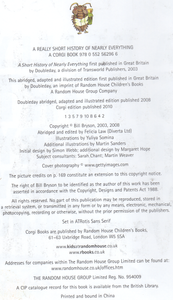
| Notes | A Corgi book A Short History of Nearly Everything first published in Great Britain by Doubleday, a division of Transworld Publishers, 2003 This abridged, adapted and illustrated edition first published in Great Britain by Doubleday, an imprint of Random House Children's Books A Random House Group Company Doubleday abridged, adapted and illustrated edition published 2008 Corgi edition published 2010 Copyright © Bill Bryson, 2003, 2008 Abridged and edited by Felicia Law (Diverta Ltd) Illustrations by Yuliya Somina Additional illustrations by Martin Sanders Initial design by Simon Webb; additional design by Margaret Hope Subject consultants: Sarah Chant; Martin Weaver Cover photography © www.gettyimages.com Corgi Books are published by Random House Children's Books Printed and bound in China Illustrations by Yuliya Somina Cover photography © Getty Images Space photography © NASA/Science Photo Library |