

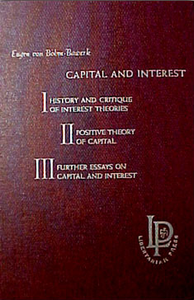
Capital and Interest: I. History and Critique of Interest Theories; II. Positive Theory of Capital; III. Further Essays on Capital and Interest
| Translated by | George D. Huncke, Hans F. Sennholz |
| Publisher | Libertarian Press, Inc. |
| Format | Hardback |
| Language | English |
| Location | South Holland, Illinois |
| Copyright | 1959 |
| First Printing | 1959 |
| This Edition Published | 1959 |
| This Impression | 1959-06 |
| Pages / Font | 1202 pages |
| Chapters | I. HISTORY AND CRITIQUE OF INTEREST THEORIES Biographical Sketch of Eugen von Böhm-Bawerk Publisher's Note on Present Edition Translators' Preface The Problem of Interest What the Theoretical Problem of Interest Deals With How the Theoretical Problem Differs from the Social Problem of Interest The Dangers of Confusing the Theoretical Problem and the Social Problem Preliminary Explanation of Some Basic Concepts The Opposition to Loan Interest on the Part of the Ancient Philosophers and the Canonists Early Preoccupation with Loan Interest LOAN INTEREST THE FIRST AND FOR LONG THE ONLY SUBJECT MATTER OF THE INTEREST THEORY. Hostility to Interest in the Earlier Periods of Civilization The Legal Prohibition of Interest in the Ancient World ARISTOTLE AND OTHER PHILOSOPHERS OF ANTIQUITY. The Christian Church Renews the Prohibition of Interest The Theoretical Foundations of Canonistic Doctrines The Defense of Loan Interest from the Sixteenth Till the Eighteenth Century. The Decline of Canon Doctrine Resistance of Economic Practice to the Canonistic Prohibition of Interest Numerous Exceptions Beginnings of Opposition, as a Principle CALVIN. MOLINEAUS. THEIR EARLIEST SUCCESSORS. BESOLD. BACON. Victory in The Netherlands of School of Economists Who Approved of Interest HUGO GROTIUS AND SALMASIUS. SALMASIUS'S DOCTRINE. Gradual Spread of Ideas Favorable to Interest in Germany JUSTI, SONNENFELS Development of Ideas on Interest in England LOCKE, STEUART, HUME, BENTHAM. Backwardness of the Romance Countries GALIANI AND BECCARIA IN ITALY. FRENCH LEGISLATORS AND WRITERS CLING TENACIOUSLY TO THE CANONISTIC DOCTRINE. POTHIER. MIRABEAU. TURGOT'S FINAL VICTORY. An Appraisal Turgot's Fructification Theory Prior to Turgot Conditions Unfavorable to Research Concerning Originary Interest WHY THIS WAS SO. FAILURE OF THE OLDER PHYSIOCRATS TO INVESTIGATE THE PROBLEM Turgot the First to Expound a General Theory of Interest Character of Turgot's Argument Defects of Turgot's Theory HE ARGUES IN A CIRCLE Adam Smith and the Development of the Interest Problem Adam Smith Had No Clearly Defined Theory Regarding Interest Smith's Contradictory Statements Contain the Germs of the Most Important Later Theories Theoretical and Socio-Political Neutrality of Smith's Ideas on Interest Growing Practical Importance of Interest Problem Enlivens the Discussion Divergences of Post-Smithian Literature; Five Principal Classifications The Colorless Theories Large Number of Colorless Writers Among Earlier German Economists SODEN, LOTZ, JAKOB, EISELEN, RAU AND OTHERS. English Colorless Writers RICARDO, TORRENS, MCCULLOCH, MACLEOD AND OTHERS Relatively Few Colorless Doctrines in France REASONS FOR THIS RARITY. G. GARNIER, CANARD, DROZ. The Productivity Theories Preliminary Survey Ambiguity of the Term, "Productivity Capital" FOUR DIFFERENT DEFINITIONS. THE DIFFERENCE BETWEEN "PHYSICAL PRODUCTIVITY" AND "PRODUCTIVITY OF VALUE." DIFFICULTIES CAUSED BY CONFUSING THEM. Nature of Theoretical Task Confronting the Productivity Theories CONCEIVABLE SOLUTIONS Catalogue of Conceivable Productivity Theories DIVISION OF ACTUAL PRODUCTIVITY THEORIES INTO GROUPS. PLAN OF PRESENTATION The Naive Productivity Theories Founded by J.B. Say. His Doctrine Say's Followers in Germany SCHÖN, RIEDEL, ROSCHER. Say's Followers in France and Italy SCIALOJA Critique of the Naive Productivity Theories Untenability of the First Variant of the Productivity Theory THIS IS BECAUSE OF THE FAILURE TO SUBSTANTIATE A DIRECT VALUE-CREATING POWER INHERENT IN CAPITAL, AND BECAUSE OF THE IRRECONCILABILITY OF THE CONCEPT WITH THE NATURE OF VALUE AND OF PRODUCTION. DETAILED REFUTATION. The Second Variant of the Productivity Theory Similarly Untenable A SURPLUS OF PRODUCTS IS NOT NECESSARILY ACCOMPANIES BY A SURPLUS OF VALUE. Summary The Motivated Productivity Theories General Characteristics Necessity for Detailed Analysis of the Several Doctrines LAUDERDALE. MALTHUS. CAREY. PESHINE SMITH. Final Conclusions The Use Theories General Characteristics Historical Statement of Use Theories J.B. Say, the Founder of the Use Theory HIS EARLIEST SUCCESSORS. STORCH, NEBENIUS, MARLO. Hermann's Detailed Exposition of the Use Theory OUTLINE OF HIS DOCTRINE. APPRAISAL. HERMANN'S SUCCESSORS. BERNHARDI, MANGOLDT, MITHOFF, SCHÄFFLE, KNIES. Menger's Maximum Development of the Use Theory PRESENTATION OF HIS DOCTRINE Critique of Use Theories The Points of Contention CRITIQUE OF THE SUE CONCEPT OF SAY-HERMANN SCHOOL Useful Natural Properties of Goods Exits THEY CONCEDEDLY POSSESS SOME MEASURE OF INDEPENDENCE. DETAILED TREATMENT. The Theory of the Use of Goods "Renditions of Service" not Identical with "Use" as Postulated by the Use Theorists THE LATER CONCEPT NOT BASED ON REALITY BUT ON AN INADMISSIBLE FICTION. FURTHER PROOFS. ALL ATTEMPTS TO DEMONSTRATE THE EXISTENCE OF THIS "USE" FAIL BECAUSE OF THE INTRUSION OF ERRORS OR MISCONCEPTIONS. Refutation of Say, Schäffle, Hermann and Knies Intrinsic Contradiction Necessarily Arising from Assumption of an Independent Use The Historical Origin of the Net Use Fiction A FICTION SERVING A LEGITIMATE PURPOSE IN LEGAL PRACTICE HAS BEEN TRANSFERRED TO THE FIELD OF ECONOMICS AND ERRONEOUSLY ENDOWED WITH EQUAL VALIDITY THERE. An Evaluation of the Feud between Salmasius and the Canonists THE TRUE NATURE OF LOANS CRITIQUE OF MENGER'S USE OF CONCEPT ASIDE FROM THE FALLACY OF THE USE CONCEPT, THE USE THEORY IS IN ANY EVENT INADEQUATE. WHY IT CANNOT POSSIBLY LEAD TO A SATISFACTORY SOLUTION OF THE PROBLEM. The Abstinence Theory Predecessors of Senior FIRST TRACES OF THE ABISTINENCE THEORY IN ENGLISH WRITIERS, SMITH AND RICARDO. MORE DEFINITE SIGNS IN NEBENIUS AND SCROPE. Senior the Real Founder of the Abstinence Theory EXPOSITION AND EVALUATION OF HIS DOCTRINE Successors of Senior BASTIAT'S DOCTRINE, AN INFERIOR VARIANT OF SENIOR'S ABSTINENCE THEORY. The Remuneration Theories The English Group THIS GROUP EXPLAINS INTEREST AS THE REMUNERATION OF LABOR ORIGINALLY PERFORMED IN ORDER TO CREATE CAPITAL GOODS. AMES MILL AND MCCULCH. The French Group THIS GROUP EXPLAINS INTEREST AS REMUNERATION OF THAT LABOR WHICH CONSISTS IN ACCUMULATING CAPITAL. The German Group THIS GROUP EXPLAINS INTEREST AS REMUNERATION FOR THE PERFORMANCE OF A NATIONAL ECONOMIC FUNCTION. RODBERTUS WAS A FORERUNNER OF THIS DOCTRINE. FURTHER DEVELOPMENT BY SCHÄFFLE AND WAGNER. CRITIQUE. THIS DOCTRINE MAY SERVE TO JUSTIFY INTEREST FROM THE SOCIAL AND POLITICAL POINT OF VIEW, BUT NOT TO FURNISH A THEORETICAL EXPLANATION OF INTEREST. John Rae Belated Recognition of Rae's Highly Original Ideas Exposition of Rae's Interest Theory Critique of Rae's Doctrine The Exploitation Theory Historical Survey of the Exploitation Theory General Characteristcs of the Exploitation Theory Origin of the Exploitation Theory EARLY FORERUNNERS. LOCK, STEUART, CONNENFELS, BÜSCH AND OTHERS. THE INFLUENCE OF THE VALUE THEORY OF SMITH AND RICARDO ON DEVELOPMENT OF THE EXPLOITATION THEORY. THOMPSON AND SISMONDI. The Socialists PROUDHON, RODBERTUS, LASSALLE, MARX. Acceptance of Exploitation Theory not Restricted to Socialists GUTH, DÜHRING, JOHN STUART MILL, SCHÄFFLE. THE "SOCIALISTS OF THE CHAIR." The Principle that Labor is the Only Source of All Value Critique of the Exploitation Theory General Outline of This Critique RODBERTUS Detailed Presentation of Rodbertus's Doctrine Deficiencies of Rodbertus's System IT IS FALLACIOUS TO MAINTAIN THAT ALL GOODS, ECONOMICALLY CONSIDERED, ARE SOLELY A PRODUCT OF LABOR. THE PRINCIPLE THAT THE WORKERS ARE ENTITLED TO THE ENTIRE VALUE OF THE PRODUCT OF THEIR LABOR IS CONCEDED, BUT IT IS MISAPPLIED BY RODBERTUS AND THE SOCIALISTS. ITS TRUE MEANING. THE ASSUMPTION THAT THE VALUE OF A GOOD IS DETERMINED BY THE COST OF LABOR IS INCORRECT. ELUCIDATION OF THE THEORETICAL FALLACY COMMITTED BY RODBERTUS. RODBERTUS'S DOCTRINE CONTRADICTS ITSELF IN IMPORTANT RESPECTS. HIS LAW OF THE GENERAL TENDENCY TOWARD THE EQUALIZATION OF ALL SUPRLUS PROCEEDS CONTRADICTS THE MOST IMPORTANT CONTENTIONS OF HIS INTEREST THEORY IN GENERAL, AND HIS THEORY OF INTEREST ON LAND IN PARTICULAR. RODBERTUS'S THEORY AS A WHOLE IS UNABLE TO OFFER ANY EXPLANATION FOR ONE IMPORTANT ASPECT OF THE ACTUAL PHENOMENON OF INTEREST. FINAL CRITIQUE OF RODBERTUS'S DOCTRINE. MARX Presentation of Marx's Theory of Value and Interest Marx's Innovations as Compared with Rodbertus THE MOST IMPORTANT IS HIS ATTEMPT TO FURNISH EXPRESS PROOF FOR THE PROPOSITION THAT THE VALUE OF ALL COMMODITIES IS CONTROLLED EXCLUSIVELY BY THE AMOUNT OF LABOR WHICH THEIR PRODUCTION COSTS. INQUIRY INTO THIS PROPOSITION. Weakness of Marx's Proof by Authority, Based as usual on Smith and Ricardo Examination and Refutation of Marx's Basic Proposition INQUIRY REVEALS IRRECONCILABILITY OF EXPERIENCE AND FACTS WITH THE LABOR THEORY OF VALUE. COMPLETE UNTENABILITY OF THAT THEORY. The Posthumous Volumes of the Marxian System THE DOCTRINE OF THE "PRICE OF PRODUCTION" AND THE "AVERAGE RATE OF PROFIT" CANNOT BE RECONCILED WITH THE ORIGINAL PROPOSITIONS OF THE MARXIAN THEORY The Marxian Doctrine as Interpreted by his Successors Attempts at New Interpretations by Sobart and K. Schmidt Bernstein's Interpretation Conclusion The Eclectics General Character of Eclecticism CRITICAL APPRAISAL. VARIOUS GROUPS OF ECLECTICS. Combinations of Productivity and Abstinence of Theories ROSSI, MOLINARI, LEROY-BEAULIEU, ROSCHER AND OTHERS. COSSA, JEVONS. Combinations Involving the Remuneration Theory ERAD, GERSTNER, CAUWÈS, J. GARNIER. Combinations of Theories Favorable and Hostile to Interest HOFFMAN, JOHN STUART MILL, SCHÄFFLE. Two More Recent Attempts Introduction Henry George's Modern Fructification Theory Expositon of George's Theory IT ASCRIBES INTEREST TO THE CREATIVE POWER OF NATURE. Objections to George's Theory IT REPEATS THE ERROR OF THE PHYSIOCRATS. IT FAILS TO EXPLAIN NOT ONLY INTEREST ON NATURALLY FRUITFUL GOODS, BUT MORE ESPECIALLY INTEREST ON CAPITAL GOODS NOT OF THAT NATURE. B. Schellwien's Modified Abistinence Theory Expostion of Schellwien's Theory Critique of Schellwien's Theory TWOFOLD INTERPRETAION OF THE CONCEPT "CONSUMPTION OF CAPITAL." RELATION OF SCHELLWIEN'S THEORY TO THE LABOR THEORY OF VALUE. Dangers of Specious Idealization of the Natural Bases of Economic Phenomena Final Conclusions The Three Basic Concepts of the Phenomenon of Interest Interest Is Not a Problem of Production, Nor of Distribution, but of Value The Rank of the Various Theories of Interest THE MOST ABASED POSITION. THE HISTORY OF THE PRESUPPOSITION THAT FORCES EXIST WHICH CREATE VALUE. THE HIGHER RANKING ITNEREST THEORIES. The Direction in Which the Final Solution of the Problem of Interest Lies THE STARTING POINT FOR PROGRESS IN THAT DIRECTION APPENDIX Recent Literature on Interest (1884 to 1914) General Survey The Agio Theory and Some Other Attempts at Explanation of Interest Use Theories; especially the Theory of Oswalt Abstinence Theories ITS DEVELOPMENT AND ESPECIALLY BY MACVANE AND MARSHALL. AN ATTEMPT AT A NEW INTERPRETATION BY CARVER. Remuneration Theories STOLZMANN'S THEORY Motivated Productivity Theories, with Particular Reference to Wieser The Exploitation Theory and Its Common Offshoot Eclectic Theories; a Defense of Eclectic Principles by Dietzel The Present State of Opinion From the Preface to the First Edition From the Preface to the Second Edition From the Preface to the Third Edition Notes Index of Authors II. POSITIVE THEORY OF CAPITAL Book I – Concept and Nature of Capital Man and Nature – Basic Conditions Underlying Production of Material Goods … 3 The Nature of Capital … 10 The Controversy Over the Concept of Capital … 16 Historical Survey … 16 My Positive Proposal … 30 Critique of the Competing Proposals … 34 Concluding Summary … 32 Social and Private Capital … 67 Book II – Capital as a Tool of Production Introduction … 77 The Capitalist Production Process … 79 An Important Phenomenon Parallel to Roundabout Methods of Production … 89 The Function of Capital in Production … 95 The Theory of the Formation of Capital … 102 Book III – Value and Price Part A – Value The Two Concepts of Value … 121 Nature and Origin of Subjective Value … 127 The Magnitude of Value. The General Principle. The Law of Marginal Utility. … 135 The Magnitude of Value Possessed by Goods Purchasable in Any Desired Quantity … 151 Specific Considerations Affecting Value Where Alternate Uses Are Possible—Use Value and Subjective Exchange Value … 156 The Value of Complementary Goods … 161 Value of Production Goods and of Goods “Of Higher Orders” Generally. Relation Between Value and Costs. … 168 Value and the Onerousness of Work (Disutility of Labor) … 177 Summary … 181 Some Psychological Considerations Supplementing Our Theory of Value … 184 Hedonism and the Theory of Value … 184 Degree of Value and Degree of Emotion … 196 The Intellectual Demands of the Process of Valuation … 201 Part B – Price Problems Confronting a Theory of Price … 205 The Basic Law of the Determination of Price … 213 Introduction … 213 Determination of Price in Isolated Exchange … 215 Determination of Price with One-sided Competition Among Buyers … 216 Determination of Price with One-sided Competition Among Sellers … 217 Determination of Price with Two-Sided Competition … 218 The Individual Determinants of Price … 234 The Law of Costs … 246 Book IV – Interest Present and Future in Economic Life … 257 Introduction … 257 First Cause … 263 Second Cause … 266 Third Cause … 271 The Origin of Interest … 288 Loans and Loan Interest the First Chief Instance … 288 The Purchase and Productive Employment of Goods of Remoter Orders: Originary Interest the Second Chief Interest … 297 Basic Principles … 297 Complications … 300 The Labor Market … 306 The General Market for Means of Subsistence … 310 Interest on Durable Goods the Third Chief Instance … 323 Conclusions … 335 Interest Under Socialism … 339 The Rate of Interest … 345 The Rate of Interest Under Individual Transactions … 345 The Rate of Interest Under Market Conditions (Simplest Hypothesis) … 349 The Rate of Interest Under the Fully Developed Market for Capital … 363 From the Preface to the First Edition … 383 From the Preface to the Third Edition (First Half-Volume) … 387 From the Preface to the Third Edition (Second Half-Volume) … 395 From the Preface to the Fourth Edition … 397 Notes … 399 Index of Authors … 463 III. FURTHER ESSAYS ON CAPITAL AND INTEREST Further Explanations and Proofs of the Rule of Greater Productivity of the Roundabout Ways of Capitalist Production … 1 (A further explanation of “The Capitalist Production Process” in Positive Theory of Capital, p. 79 ff.) Explanations … 2 Evidence … 14 Concerning the Relative Frequency of Inventions that Lengthen of Shorten the Customary Production Period … 24 (A further explanation of “The Capitalist Production Process” in Positive Theory of Capital, p. 79 ff.) On Certain Epistemological Objections Against My Thesis of the Higher Productivity of Longer Roundabout Methods of Production … 34 (A further explanation of “The Capitalist Production Process” in Positive Theory of Capital, p. 79 ff., and on p. 14 f. of Essay I.) Concerning the Bearing of “Selection” on the Greater Productivity of Longer Roundabout Methods of Production … 45 (A further explanation of “The Capitalist Production Process” in Positive Theory of Capital, p. 79 ff., and Note 9 of Essay I.) Is “Production with More Capital per Capita” Identical with “Production by Longer Roundabout Methods”? … 57< (A further explanation of “The Capitalist Production Process” in Positive Theory of Capital, p. 79 ff., and Note 55 of Essay I.) /li> A Reply to Dr. Robert Meyer’s Objections to my Critique of the Exploitation Theory … 74 (A further explanation of my critique of “The Exploitation Theory” in History and Critique of Interest Theories, p. 241 ff., and of “Social and Private Capital” in Positive Theory of Capital, p. 67 ff. Cf. especially Note 7 of that chapter.) On the Theory of Value of Complementary Goods and the Theory of Imputation … 78 (A further explanation of “The Value of Complementary Goods” in Positive Theory of Capital, p. 161 ff.) On the Value of Producers’ Goods and the Relationship between Value and Costs … 97 (A further explanation of the “Value of Production Goods and of Goods ‘Of Higher Orders’ Generally. Relation Between Value and Costs” in Positive Theory of Capital, p. 168 ff.) On the Role of Disutility in the Value Theory … 116 (A further explanation of “Value and the Onerousness of Work (Disutility of Labor)” in Positive Theory of Capital, p. 177 ff.) On the “Measurability” of Sensations … 124 (A further explanation of the “Degree of Value and Degree of Emotion” in Positive Theory of Capital, p. 196 ff.) On the Motivation of Present Economic Actions by Future Wants … 137 (A further explanation of “Present and Future in Economic Life” in Positive Theory of Capital, p. 257 ff.) On the Relationship between the “Third Reason” for Higher Valuation of Present Goods and the Two Other Reasons … 150 (A further explanation of “Present and Future in Economic Life” in Positive Theory of Capital, p. 271 ff.) Bortkiewicz … 152 Irving Fisher … 162 Fisher’s Section 4 and Mathematical Appendix … 162 Fisher’s Section 5 … 169 Fisher’s Section 6 … 176 Fisher’s Section 7 … 179 Fisher’s Own Arrangement of the Causes of Higher Valuation … 183 On the Historical Development of the Theory of Durable Goods within the Capital Theory. Some Critical Remarks on the Interest Theories by Cassel and Landry. … 194 (A further explanation of “An Important Phenomenon Parallel to Roundabout Methods of Production” in Positive Theory of Capital, p. 89 ff., and of “Present and Future in Economic Life” in Positive Theory of Capital, p. 280 ff.) On the Size of the Initial Fund that is Necessary for a Production Period of a Certain Duration … 211 (A further explanation of “The General Market for Means of Subsistence” in Positive Theory of Capital, especially p. 316 ff.) Notes … 213 Index of Authors … 243 |
| Notes | Capital and Interest is Böhm Bawerk's magnum opus, one of the greatest achievements in the history of economic thought. In fact, it is a Magna Carta of the capitalistic production process. In an economic order based on production, income from capital investment provides the very basis of the system and a livelihood for a large middle-class, as well as capitalists and entrepreneurs. All observations about the nature and appraisals of the value of capitalism hinge upon the explanation of this capital income. Capital and Interest is divided into three parts: The first volume, History and Critque of Interest Theories, is a diligent and persuasive analysis of virtually all capital income theories. It is a critical history of interest doctrines that defend or oppose capital income. The second volume, Positive Theory of Capital, contains much more than the title seems to indicate. It presents a comprehensive theory of the entire production process. In particular, it elaborates on the principles that govern the allocation of incomes, that is, the amounts of interest, wage, and profit. Böhm-Bawerk offers a persuasive solution to all questions of income and theories of distribution. In Volume III, Further Essays on Capital and Interest, the publisher collected additional explanations and commentaries by the author. It comprises fourteen brilliant briefs explaining, elaborating, and defending the Positive Theory. It contains such great essays as "The Role of Disutility in the Value Theory" and "The Size of the Initial Fund That is Necessary for a Given Production Period." Capital and Interest is available in a three-volume set, or a three-in-one volume edition. In either form, it is a handsome, necessary addition to the complete Free Market library. |
Added by kaarlotuomi