

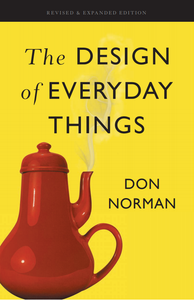
The Design of Everyday Things: Revised and Expanded Edition
| Book | The Design of Everyday Things |
| Format | e-Book |
| Language | English |
| Copyright | 2013 |
Collection
| Author | Don Norman |
| Imprint | Basic Books |
| Publisher | Perseus Books Group |
| Copyright Holder | Don Norman |
| About/Subject | Industrial Design, Human Engineering |
| Format | e-Book |
| Language | English |
| Location | New York |
| Copyright | 2013 |
| ISBN 13 | 978-0-465-00394-5 |
| Chapters | Preface to the Revised Edition
1 The Psychopathology of Everyday Things
The Complexity of Modern Devices
Human-Centered Design
Fundamental Principles of Interaction
The System Image
The Paradox of Technology
The Design Challenge
2 The Psychology of Everyday Actions
How People Do Things: The Gulfs of Execution and Evaluation
The Seven Stages of Action
Human Thought: Mostly Subconscious
Human Cognition and Emotion
The Seven Stages of Action and the Three Levels of Processing
People as Storytellers
Blaming the Wrong Things
Falsely Blaming Yourself
The Seven Stages of Action: Seven Fundamental Design Principles
3 Knowledge in the Head and in the World
Precise Behavior from Imprecise Knowledge
Memory Is Knowledge in the Head
The Structure of Memory
Approximate Models: Memory in the Real World
Knowledge in the Head
The Tradeoff Between Knowledge in the World and in the Head
Memory in Multiple Heads, Multiple Devices
Natural Mapping
Culture and Design: Natural Mappings Can Vary with Culture
4 Knowing What to Do: Constraints
Discoverability, and Feedback
Four Kinds of Constraints: Physical, Cultural, Semantic, and Logical
Applying Affordances, Signifiers, and Constraints to Everyday Objects
Constraints That Force the Desired Behavior
Conventions, Constraints, and Affordances
The Faucet: A Case History of Design
Using Sound as Signifiers
5 Human Error? No, Bad Design
Understanding Why There Is Error
Deliberate Violations
Two Types of Errors: Slips and Mistakes
The Classification of Slips
The Classification of Mistakes
Social and Institutional Pressures
Reporting Error
Detecting Error
Designing for Error
When Good Design Isn’t Enough
Resilience Engineering
The Paradox of Automation
Design Principles for Dealing with Error
6 Design Thinking
Solving the Correct Problem
The Double-Diamond Model of Design
The Human-Centered Design Process
What I Just Told You? It Doesn’t Really Work That Way
The Design Challenge
Complexity Is Good; It Is Confusion That Is Bad
Standardization and Technology
Deliberately Making Things Difficult
Design: Developing Technology for People
7 Design in the World of Business
Competitive Forces
New Technologies Force Change
How Long Does It Take to Introduce a New Product?
Two Forms of Innovation: Incremental and Radical
The Design of Everyday Things: 1988–2038
The Future of Books
The Moral Obligations of Design
Design Thinking and Thinking About Design
Acknowledgments
General Readings and Notes
References
Index Preface to the Revised Edition
1 The Psychopathology of Everyday Things
The Complexity of Modern Devices
Human-Centered Design
Fundamental Principles of Interaction
The System Image
The Paradox of Technology
The Design Challenge
2 The Psychology of Everyday Actions
How People Do Things: The Gulfs of Execution and Evaluation
The Seven Stages of Action
Human Thought: Mostly Subconscious
Human Cognition and Emotion
The Seven Stages of Action and the Three Levels of Processing
People as Storytellers
Blaming the Wrong Things
Falsely Blaming Yourself
The Seven Stages of Action: Seven Fundamental Design Principles
3 Knowledge in the Head and in the World
Precise Behavior from Imprecise Knowledge
Memory Is Knowledge in the Head
The Structure of Memory
Approximate Models: Memory in the Real World
Knowledge in the Head
The Tradeoff Between Knowledge in the World and in the Head
Memory in Multiple Heads, Multiple Devices
Natural Mapping
Culture and Design: Natural Mappings Can Vary with Culture
4 Knowing What to Do: Constraints
Discoverability, and Feedback
Four Kinds of Constraints: Physical, Cultural, Semantic, and Logical
Applying Affordances, Signifiers, and Constraints to Everyday Objects
Constraints That Force the Desired Behavior
Conventions, Constraints, and Affordances
The Faucet: A Case History of Design
Using Sound as Signifiers
5 Human Error? No, Bad Design
Understanding Why There Is Error
Deliberate Violations
Two Types of Errors: Slips and Mistakes
The Classification of Slips
The Classification of Mistakes
Social and Institutional Pressures
Reporting Error
Detecting Error
Designing for Error
When Good Design Isn’t Enough
Resilience Engineering
The Paradox of Automation
Design Principles for Dealing with Error
6 Design Thinking
Solving the Correct Problem
The Double-Diamond Model of Design
The Human-Centered Design Process
What I Just Told You? It Doesn’t Really Work That Way
The Design Challenge
Complexity Is Good; It Is Confusion That Is Bad
Standardization and Technology
Deliberately Making Things Difficult
Design: Developing Technology for People
7 Design in the World of Business
Competitive Forces
New Technologies Force Change
How Long Does It Take to Introduce a New Product?
Two Forms of Innovation: Incremental and Radical
The Design of Everyday Things: 1988–2038
The Future of Books
The Moral Obligations of Design
Design Thinking and Thinking About Design
Acknowledgments
General Readings and Notes
References
Index Show all ▾ |
Added by auboisdormant