

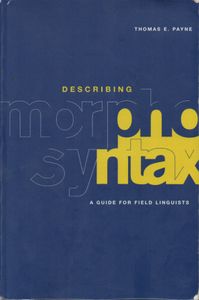

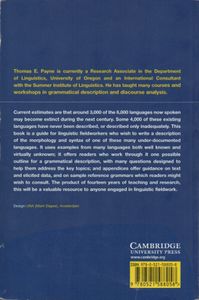
Describing Morphosyntax: A Guide for Field Linguists
| Format | Paperback |
| Language | English |
| Copyright | 1997 |
| Designed by | Mark Diaper |
| Designed at | UNA, Amsterdam |
| Publisher | Cambridge University Press |
| Format | Paperback |
| Language | English |
| Location | Cambridge University Press, New York |
| Copyright | 1997 |
| Printed | 2014 |
| Pages / Font | 413 pages |
| Barcode | 9 780521 588058 |
| ISBN 13 | 978-0-521-58805-8 |
| Impression/Printing No. | 14 |
| Chapters | 0 Introduction
0.1 The purpose of this book
0.2 Some terminology and recurring metaphors
0.3 Conclusion
1 Demographic and ethnographic information
1.1 The name of the language
1.2 Ethnology
1.3 Demography
1.4 Genetic affiliation
1.5 Previous research
1.6 The sociolinguistic situation
1.7 Dialects
2 Morphological typology
2.0 Historical background and definitions
2.1 Traditional morphological typology
2.2 Morphological processes
2.3 Head/dependent marking
3 Grammatical catrgories
3.1 Nouns
3.2 Verbs
3.3 Modifiers
3.4 Adverbs
4 Constituent order typology
4.0 Introduction
4.1 Constituent order in main clauses
4.2 Verb phrase
4.3 Noun phrase
4.4 Adpositional phrases (prepositions and postpostitions)
4.5 Comparatives
4.6 Question particles and question words
4.7 Summary
5 Noun and noun-phrase operations
5.1 Compounding
5.2 Denominalization
5.3 Number
5.4 Case
5.5 Articles, determiners, and demonstratives
5.6 Possessors
5.7 Class (including gender)
5.8 Diminution/augmentation
6 Predicate nominals and related constructions
6.1 Predicate nominals
6.2 Predicate adjectives (attributive clauses)
6.3 Predicate locatives
6.4 Existentials
6.5 Possessive clauses
6.6 Summary of predicate nominal and EPL relationships
7 Grammatical relations
7.1 Systems for grouping S, A, and P
7.2 Functional explanations for groupings of S, A, and P
7.3 Split systems
7.4 "Syntactic" ergativity
7.5 Summary
8 Voice and valence adjusting operations
8.0 Valence and predicate calculus
8.1 Valence increasing operations
8.2 Valence decreasing operations
9 Other verb and verb-phrase operations
9.1 Nominalization
9.2 Compounding (including incorporation)
9.3 Tense/aspect/mode
9.4 Location/direction
9.5 Participant reference
9.6 Evidentiality, validationality, and mirativity
9.7 Miscellaneous
10 Pragmatically marked structures
10.0 Pragmatic statues
10.1 The morphosyntax of focus, contrast, and "topicalization"
10.2 Negation
10.3 Non-declarative speech
11 Clause combinations
11.1 Serial verbs
11.2 Complement clauses
11.3 Adverbial clauses
11.4 Clause chaining, medial clauses, and switch reference
11.5 Relative clauses
11.6 Coordination
12 Conclusions: the language in use
12.0 Discourse analysis and linguistic analysis
12.1 Continuity (cohesion) and discontinuity
12.2 Genres
12.3 Miscellaneous 0 Introduction
0.1 The purpose of this book
0.2 Some terminology and recurring metaphors
0.3 Conclusion
1 Demographic and ethnographic information
1.1 The name of the language
1.2 Ethnology
1.3 Demography
1.4 Genetic affiliation
1.5 Previous research
1.6 The sociolinguistic situation
1.7 Dialects
2 Morphological typology
2.0 Historical background and definitions
2.1 Traditional morphological typology
2.2 Morphological processes
2.3 Head/dependent marking
3 Grammatical catrgories
3.1 Nouns
3.2 Verbs
3.3 Modifiers
3.4 Adverbs
4 Constituent order typology
4.0 Introduction
4.1 Constituent order in main clauses
4.2 Verb phrase
4.3 Noun phrase
4.4 Adpositional phrases (prepositions and postpostitions)
4.5 Comparatives
4.6 Question particles and question words
4.7 Summary
5 Noun and noun-phrase operations
5.1 Compounding
5.2 Denominalization
5.3 Number
5.4 Case
5.5 Articles, determiners, and demonstratives
5.6 Possessors
5.7 Class (including gender)
5.8 Diminution/augmentation
6 Predicate nominals and related constructions
6.1 Predicate nominals
6.2 Predicate adjectives (attributive clauses)
6.3 Predicate locatives
6.4 Existentials
6.5 Possessive clauses
6.6 Summary of predicate nominal and EPL relationships
7 Grammatical relations
7.1 Systems for grouping S, A, and P
7.2 Functional explanations for groupings of S, A, and P
7.3 Split systems
7.4 "Syntactic" ergativity
7.5 Summary
8 Voice and valence adjusting operations
8.0 Valence and predicate calculus
8.1 Valence increasing operations
8.2 Valence decreasing operations
9 Other verb and verb-phrase operations
9.1 Nominalization
9.2 Compounding (including incorporation)
9.3 Tense/aspect/mode
9.4 Location/direction
9.5 Participant reference
9.6 Evidentiality, validationality, and mirativity
9.7 Miscellaneous
10 Pragmatically marked structures
10.0 Pragmatic statues
10.1 The morphosyntax of focus, contrast, and "topicalization"
10.2 Negation
10.3 Non-declarative speech
11 Clause combinations
11.1 Serial verbs
11.2 Complement clauses
11.3 Adverbial clauses
11.4 Clause chaining, medial clauses, and switch reference
11.5 Relative clauses
11.6 Coordination
12 Conclusions: the language in use
12.0 Discourse analysis and linguistic analysis
12.1 Continuity (cohesion) and discontinuity
12.2 Genres
12.3 Miscellaneous Show all ▾ |
| Notes | Design UNA (Mark Diaper), Amsterdam University Printing House, Cambridge CB2 8BS, United Kingdom Printed in the United Kingdom by CPI Group Ltd, Croydon CR0 4YY |
Added by Efhughes