

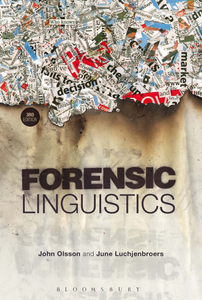
Forensic Linguistics, Third Edition
| Book | Forensic Linguistics |
| Format | e-Book |
| Language | English |
| Copyright | 2014 |
Collection
| Author | John Olsson, June Luchjenbroers |
| Imprint | Bloomsbury, Bloomsbury Academic |
| Publisher | Bloomsbury Publishing Plc |
| Copyright Holder | John Olsson, June Luchjenbroers |
| About/Subject | Forensic Linguistics, Linguistics, Forensic Science |
| Format | e-Book |
| Language | English |
| Location | London; New Delhi; New York; Sydney |
| Copyright | 2014 |
| ISBN 13 | 978-1-4725-6957-8 |
| Chapters | List of figures
List of tables
Acknowledgements
Foreword
Who should use this book?
About the authors
INTRODUCTION
What is forensic linguistics?
The language of the law: Meaning
The discourse of the law
Authorship attribution
History of forensic linguistics in practice
Outline of this book
PART ONE: LANGUAGE AS FORENSIC EVIDENCE
Introduction to Part One
1 The road to authorship
The beginnings of literacy
The role of memory in language
Orality in early written language
The transition from orality to literacy
The first author?
Conclusion
2 The author constructed
The doctrine of authorship
Authorship as an individual act
Text as property
The genius of the author
Style
Social factors and language style
Aspects of style
Conclusion
3 Time, variation and genre
Introduction
Expected and unexpected relationships in the genre domain
The genre institution and the author space
Comparison across genres
Testing author-genre relationships
A corpus of 32 novels
Entropy and ectropy in the language system
Conclusion
4 Range of variation
Individual range variation
Variation and interpersonal relationships
Is variation random?
The token 'you' as a variable in the mobile phone text corpus
The '-ing' inflection
Conclusion
5 Textual variation
Register factors
Non-register factors
Polyphonic factors
Conclusion
6 Forensic phonetics: An introduction by Harry Hollien
Defining forensic phonetics
Signal analysis
Speech decoding and transcripts
Authenticating recordings
Behavioural analyses
The aural–perceptual approach
Machine–computer approaches
Natural speech vectors
Validating the approach
Detecting behaviour from voice
Alcohol–speech relationships
Detection of deception
Evaluations
Forensic phonetics continues to develop
7 Cybercrime
Introduction
Types of e-crime
Conclusion
PART TWO: DEALING WITH LINGUISTIC EVIDENCE
Introduction to Part Two
8 Forensic texts
What types of forensic text are there?
What are typical features of different types of forensic text?
9 Forensic transcription
The text is the evidence
Transcription exercises of audio material
10 Forensic authorship in practice
Introduction
Notes on preliminary procedures
An example of imitation
Exercise commentaries
11 Investigating author variation in naturalistic data
The corpus
The texts
Variables
The study
Conclusion regarding the experiment into naturalistic data
12 Forensic linguistic evidence in court
The texts in the case
The features in the texts
Excerpts from prosecution reports
Conclusion
PART THREE: THE LEGAL PROCESS: LANGUAGE AND THE LAW
Introduction to Part Three
13 Power in legal contexts: The courts
Power in court
Rules of questioning
Linguistic disadvantages before the law
Conclusion
14 Power in legal contexts: The police
Situational features and rules of behaviour
'Verballing' in police testimonies
Police and the 'right to silence'
Conclusion
15 Vulnerable witnesses
Vulnerability and the law
Children as vulnerable witnesses
'Intimidated' witnesses and rape
Disabilities and the legal process
Courtroom interpreting and translation
LADO assessments and the forensic linguist
Conclusion
PART FOUR: LANGUAGE OF THE LAW
Introduction to Part Four
16 The law and us
The meaning of words
What does malice mean?
Conclusion
17 The language of statutes
The language of statutes and the language of courts
Am I entitled to a lawyer?
In all criminal prosecutions
High legal art and judicial disingenuousness
The grading of probability
Where actus commences
Attitude to risk
Conclusion
Appendix 1: Forensic texts
Appendix 2: Exercises and exercise commentaries
Appendix 3: Active researchers in the field of forensic linguistics
Bibliography
Author Index
Subject Index List of figures
List of tables
Acknowledgements
Foreword
Who should use this book?
About the authors
INTRODUCTION
What is forensic linguistics?
The language of the law: Meaning
The discourse of the law
Authorship attribution
History of forensic linguistics in practice
Outline of this book
PART ONE: LANGUAGE AS FORENSIC EVIDENCE
Introduction to Part One
1 The road to authorship
The beginnings of literacy
The role of memory in language
Orality in early written language
The transition from orality to literacy
The first author?
Conclusion
2 The author constructed
The doctrine of authorship
Authorship as an individual act
Text as property
The genius of the author
Style
Social factors and language style
Aspects of style
Conclusion
3 Time, variation and genre
Introduction
Expected and unexpected relationships in the genre domain
The genre institution and the author space
Comparison across genres
Testing author-genre relationships
A corpus of 32 novels
Entropy and ectropy in the language system
Conclusion
4 Range of variation
Individual range variation
Variation and interpersonal relationships
Is variation random?
The token 'you' as a variable in the mobile phone text corpus
The '-ing' inflection
Conclusion
5 Textual variation
Register factors
Non-register factors
Polyphonic factors
Conclusion
6 Forensic phonetics: An introduction by Harry Hollien
Defining forensic phonetics
Signal analysis
Speech decoding and transcripts
Authenticating recordings
Behavioural analyses
The aural–perceptual approach
Machine–computer approaches
Natural speech vectors
Validating the approach
Detecting behaviour from voice
Alcohol–speech relationships
Detection of deception
Evaluations
Forensic phonetics continues to develop
7 Cybercrime
Introduction
Types of e-crime
Conclusion
PART TWO: DEALING WITH LINGUISTIC EVIDENCE
Introduction to Part Two
8 Forensic texts
What types of forensic text are there?
What are typical features of different types of forensic text?
9 Forensic transcription
The text is the evidence
Transcription exercises of audio material
10 Forensic authorship in practice
Introduction
Notes on preliminary procedures
An example of imitation
Exercise commentaries
11 Investigating author variation in naturalistic data
The corpus
The texts
Variables
The study
Conclusion regarding the experiment into naturalistic data
12 Forensic linguistic evidence in court
The texts in the case
The features in the texts
Excerpts from prosecution reports
Conclusion
PART THREE: THE LEGAL PROCESS: LANGUAGE AND THE LAW
Introduction to Part Three
13 Power in legal contexts: The courts
Power in court
Rules of questioning
Linguistic disadvantages before the law
Conclusion
14 Power in legal contexts: The police
Situational features and rules of behaviour
'Verballing' in police testimonies
Police and the 'right to silence'
Conclusion
15 Vulnerable witnesses
Vulnerability and the law
Children as vulnerable witnesses
'Intimidated' witnesses and rape
Disabilities and the legal process
Courtroom interpreting and translation
LADO assessments and the forensic linguist
Conclusion
PART FOUR: LANGUAGE OF THE LAW
Introduction to Part Four
16 The law and us
The meaning of words
What does malice mean?
Conclusion
17 The language of statutes
The language of statutes and the language of courts
Am I entitled to a lawyer?
In all criminal prosecutions
High legal art and judicial disingenuousness
The grading of probability
Where actus commences
Attitude to risk
Conclusion
Appendix 1: Forensic texts
Appendix 2: Exercises and exercise commentaries
Appendix 3: Active researchers in the field of forensic linguistics
Bibliography
Author Index
Subject Index Show all ▾ |
Added by auboisdormant