

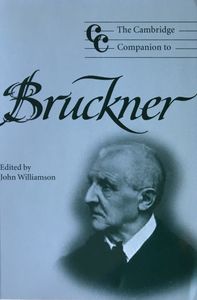
| Editor | John Williamson |
| About/Subject | Anton Bruckner |
| Publisher | Cambridge University Press |
| Publisher Series | Cambridge Companions To Music |
| Printed by | University Press, Cambridge |
| Contributing Writer | John Williamson, Andrea Harrandt, Paul Hawkshaw, A. Crawford Howie, Derek B. Scott, Benjamin M. Korstvedt, Julian Horton, Margaret Notley, Kevin Swinden, Christa Brüstle |
| Calligraphy by | Stephen Raw |
| Format | Paperback |
| Language | English |
| Copyright | 2004 |
| Pages / Font | 303 pages |
| ISBN | 0-521-00878-6 |
| Barcode | 9 780521 008785 |
| Chapters | Part I Background
1. Introduction: a Catholic composer in the age of Bismarck (John Williamson)
2. Musical life in Upper Austria in the mid-nineteenth century (Andrea Harrandt)
3. Bruckner in Vienna (Andrea Harrandt)
Part II Choral music
4. Bruckner's large sacred compositions (Paul Hawkshaw)
5. Bruckner and the motet (A. Crawford Howie)
6. Bruckner and secular vocal music (A. Crawford Howie)
Part III The symphonist
7. The Brucknerian symphony: an overview (John Williamson)
8. Bruckner's symphonies - a reinterpretation: the dialectic of darkness and light (Derek B. Scott)
9. Programme symphony and absolute music (John Williamson)
10. Bruckner editions: the revolution revisited (Benjamin M. Korstvedt)
11. Bruckner and the symphony orchestra (Julian Horton)
12. Between formlessness and formality: aspects of Bruckner's approach to symphonic form (Benjamin M. Korstvedt)
13. Formal process as spiritual progress: the symphonic slow movements (Margaret Notley)
14. Bruckner and harmony (Kevin Swinden)
Part IV Reception
15. Conductors and Bruckner (John Williamson)
16. The musical image of Bruckner (Christa Brüstle) Part I Background
1. Introduction: a Catholic composer in the age of Bismarck (John Williamson)
2. Musical life in Upper Austria in the mid-nineteenth century (Andrea Harrandt)
3. Bruckner in Vienna (Andrea Harrandt)
Part II Choral music
4. Bruckner's large sacred compositions (Paul Hawkshaw)
5. Bruckner and the motet (A. Crawford Howie)
6. Bruckner and secular vocal music (A. Crawford Howie)
Part III The symphonist
7. The Brucknerian symphony: an overview (John Williamson)
8. Bruckner's symphonies - a reinterpretation: the dialectic of darkness and light (Derek B. Scott)
9. Programme symphony and absolute music (John Williamson)
10. Bruckner editions: the revolution revisited (Benjamin M. Korstvedt)
11. Bruckner and the symphony orchestra (Julian Horton)
12. Between formlessness and formality: aspects of Bruckner's approach to symphonic form (Benjamin M. Korstvedt)
13. Formal process as spiritual progress: the symphonic slow movements (Margaret Notley)
14. Bruckner and harmony (Kevin Swinden)
Part IV Reception
15. Conductors and Bruckner (John Williamson)
16. The musical image of Bruckner (Christa Brüstle) Show all ▾ |
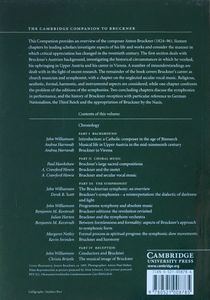
| Notes | Back cover text: This Companion provides an overview of the composer Anton Bruckner (1824-96). Sixteen chapters by leading scholars investigate aspects of his life and works and consider the manner in which critical appreciation has changed in the twentieth century. The first section deals with Bruckner's Austrian background, investigating the historical circumstances in which he worked, his upbringing in Upper Austria and his career in Vienna. A number of misunderstandings are dealt with in the light of recent research. The remainder of the book covers Bruckner's career as church musician and symphonist, with a chapter on the neglected secular vocal music. Religious, aesthetic, formal, harmonic, and instrumental aspects are considered, while one chapter confronts the problem of the editions of the symphonies. Two concluding chapters discuss the symphonies in performance, and the history of the Bruckner-reception with particular reference to German Nationalism, the Third Reich and the appropriation of Bruckner by the Nazis. |
Added by IvarDV