

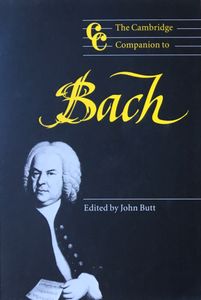
| Editor | John Butt (2) |
| About/Subject | Johann Sebastian Bach |
| Publisher | Cambridge University Press |
| Publisher Series | Cambridge Companions To Music |
| Printed by | University Press, Cambridge |
| Contributing Writer | John Butt (2), Malcolm Boyd, Ulrich Siegele, Robin A. Leaver, Stephen A. Crist, Werner Breig, Richard D. P. Jones, Laurence Dreyfus, Stephen Daw, George B. Stauffer, Martin Zenck |
| Calligraphy by | Stephen Raw |
| Format | Paperback |
| Language | English |
| Copyright | 1997 |
| Reprinted | 2001 |
| Pages / Font | 326 pages |
| ISBN | 0-521-58780-8 |
| Barcode | 9 780521 587808 |
| Chapters | Introduction (John Butt)
Part I: The historical context: society, beliefs and world-view
1. The Bach family (Malcolm Boyd)
2. Bach and the domestic politics of Electoral Saxony (Ulrich Siegele)
3. Music and Lutheranism (Robin A. Leaver)
4. Bach's metaphysics of music (John Butt)
5. 'A mind unconscious that it is calculating'? Bach and the rationalist philosophy of Wolff, Leibniz and Spinoza (John Butt)
Part II: Profiles of the music
6. The early works and the heritage of the seventeenth century (Stephen A. Crist)
7. The mature vocal works and their theological and liturgical context (Robin A. Leaver)
8. The instrumental music (Werner Breig)
9. The keyboard works: Bach as teacher and virtuoso (Richard D. P. Jones)
10. Composition as arrangement and adaptation (Werner Breig)
11. Bachian invention and its mechanisms (Laurence Dreyfus)
Part III: Influence and reception
12. Bach as teacher and model (Stephen Daw)
13. Changing issues of performance practice (George B. Stauffer)
14. Bach reception: some concepts and parameters (Martin Zenck)
15. Reinterpreting Bach in the nineteenth and twentieth centuries (Martin Zenck) Introduction (John Butt)
Part I: The historical context: society, beliefs and world-view
1. The Bach family (Malcolm Boyd)
2. Bach and the domestic politics of Electoral Saxony (Ulrich Siegele)
3. Music and Lutheranism (Robin A. Leaver)
4. Bach's metaphysics of music (John Butt)
5. 'A mind unconscious that it is calculating'? Bach and the rationalist philosophy of Wolff, Leibniz and Spinoza (John Butt)
Part II: Profiles of the music
6. The early works and the heritage of the seventeenth century (Stephen A. Crist)
7. The mature vocal works and their theological and liturgical context (Robin A. Leaver)
8. The instrumental music (Werner Breig)
9. The keyboard works: Bach as teacher and virtuoso (Richard D. P. Jones)
10. Composition as arrangement and adaptation (Werner Breig)
11. Bachian invention and its mechanisms (Laurence Dreyfus)
Part III: Influence and reception
12. Bach as teacher and model (Stephen Daw)
13. Changing issues of performance practice (George B. Stauffer)
14. Bach reception: some concepts and parameters (Martin Zenck)
15. Reinterpreting Bach in the nineteenth and twentieth centuries (Martin Zenck) Show all ▾ |
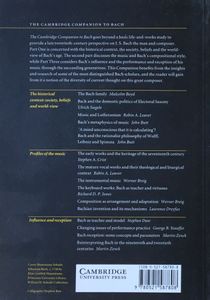
| Notes | Back cover text: The Cambridge Companion to Bach goes beyond a basic life-and-works study to provide a late twentieth-century perspective on J. S. Bach the man and composer. Part One is concerned with the historical context, the society, beliefs and the world-view of Bach's age. The second part discusses the music and Bach's compositional style, while Part Three considers Bach's influence and the performance and reception of his music through the succeeding generations. This Companion benefits from the insights and research of some of the most distinguished Bach scholars, and the reader will gain from it a notion of the diversity of current thought on this great composer. |
Added by IvarDV