

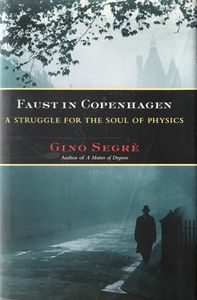
Faust in Copenhagen: A Struggle for the Soul of Physics
| Format | Hardback |
| Language | English |
| Copyright | 2007 |
| About/Subject | Niels Bohr, Wolfgang Pauli, Paul Dirac, Werner Heisenberg, Paul Ehrenfest, Lise Meitner, Max Delbrück |
| Imprint | Viking |
| Publisher | Penguin Group |
| Copyright Holder | Gino Segré |
| Designed by | Francesca Belanger |
| Cover/Jacket Design by | Herb Thornby |
| Format | Hardback |
| Language | English |
| Copyright | 2007 |
| Pages / Font | 310 pages / Electra and Cloister |
| ISBN | 978-0-670-03858-9 |
| Barcode | 9 780670 038589 52595 |
| Chapters | Introduction
1. Munich Then and Now
2. The Changing Times
3. Goethe and Faust
4. The Front Row: The Old Guard
5. The Front Row: The Revolutionaries
6. The Front Row: The Young Ones
7. The Coming Storm
8. The Revolution Begins
9. The King In Decline
10. The Great Synthesis
11. Conservation of Energy
12. The New Generation Comes of Age
13. The Miracle Year
14. Ehrenfest's End
Epilogue: Or What Happened to the Front Row's Other Six
Coda Introduction
1. Munich Then and Now
2. The Changing Times
3. Goethe and Faust
4. The Front Row: The Old Guard
5. The Front Row: The Revolutionaries
6. The Front Row: The Young Ones
7. The Coming Storm
8. The Revolution Begins
9. The King In Decline
10. The Great Synthesis
11. Conservation of Energy
12. The New Generation Comes of Age
13. The Miracle Year
14. Ehrenfest's End
Epilogue: Or What Happened to the Front Row's Other Six
Coda Show all ▾ |
| Notes | Inner flap text: it is April 1932 at Niels Bohr's Copenhagen Institute. About forty scientists have come together for their once-a-year chance to work, socialize, gossip, and prod and badger each other in a freewheeling discussion about the future of physics, all under the watchful eye of their beloved mentor. They have much to talk about for this is a pivotal moment in science, in their own careers, and, sadly, in the history of their countries. Known by physicists as the miracle year, 1932 saw the discovery of the neutron and antimatter as well as the first artificially induced nuclear transmutations. However, while scientists celebrated these momentous discoveries, which presaged the nuclear era and the emergence of big science, Europe was moving inexorably toward totalitarianism and war. Within less than a year, Hitler's ascent to power changed the lives of these scientists and rendered it impossible to recreate the happy, carefree atmosphere of the 1932 gathering. A physicist himself, Gino Segré writes about what scientists do - and why they do it- with intimacy and passion. His book centers on the lives and careers of seven physicists who dominated the Copenhagen Meeting. Three of them -Bohr, Paul Ehrenfest and Lise Meitner- are in their fifties, established members of the older generation. Three of them -Werner Heisenberg, Wolfgang Pauli and Paul Dirac- are only thirty, but already in the pantheon of the physics greats. The youngest, Max Delbrück, age twenty-five, is the author of the satiric kit that concludes the meeting, a session where the young physicists poke fun at their elders. An adaptation to the world of physics of Goethe's Faust, the skit eerily foreshadows many of the events that will come to pass. The discoveries of 1932 bring the first glimmerings of the nuclear weapons that will move physicists into the world of nations' power struggles. It was the quiet before the storm. Capturing the interplay between the great scientists as well as the discoveries they discussed and debated, Segré evokes the moment when physics - and the world- was about to lose its innocence forever. |
Added by IvarDV