


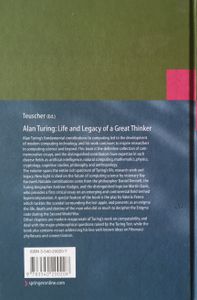
Alan Turing: Life and Legacy of a Great Thinker
| Format | Hardback |
| Language | English |
| Copyright | 2004 |
| Editor | Christof Teuscher |
| About/Subject | Alan Turing |
| Publisher | Springer |
| Copyright Holder | Springer-Verlag Berlin Heidelberg |
| Foreword by | Douglas R. Hofstadter |
| Contributing Writer | Andrew Hodges, Valeria Patera, Daniela Cerqui, Michael J. Beeson, Mike Stannett, Eugene Eberbach, Dina Goldin, Peter Wegner, Martin Davis, Christopher G. Timpson, Hector Fabio Restrepo, Gianluca Tempesti, Daniel Mange, Andrew J. Wells, Daniel Dennett, B. Jack Copeland, Diane Proudfoot, Helmut Schnelle, Ray Kurzweil, Elisabeth Rakus-Andersson, Tony Sale, Lee A. Gladwin, Jonathan Swinton, Christof Teuscher |
| Cover/Jacket Design by | Künkel und Lopka, Heidelberg |
| Printed by | Strauss Offsetdruck GmbH |
| Bound by | J. Schäffer, Grünstadt |
| Format | Hardback |
| Language | English |
| Copyright | 2004 |
| Pages / Font | 542 pages |
| ISBN | 3-540-20020-7 |
| Barcode | 9 783540 200208 |
| Chapters | Foreword (Douglas Hofstadter)
Preface (Cristof Teuscher, Daniel Mange)
Part I. Turing's Life and Thoughts
Alan Turing: an Introductory Biography (Andrew Hodges)
Alan's Apple: Hacking the Turing Test (Valeria Patera)
What Would Alan Turing Have Done After 1954? (Andrew Hodges)
From Turing to the Information Society (Daniela Cerqui)
Part II. Computation and Turing Machines
The Mechanization of Mathematics (Michael J. Beeson)
Hypercomputational Models (Mike Stannett)
Turing's Ideas and Models of Computation (Eugene Eberbach, Dina Goldin, Peter Wegner)
The Myth of Hypercomputation (Martin Davis)
Quantum Computers: the Church-Turing Hypothesis Versus the Turing Principle (Christopher G. Timpson)
Implementation of a Self-replicating Universal Turing Machine (Hector Fabio Restrepo, Gianluca Tempestri, Daniel Mange)
Cognitive Science and the Turing Machine: an Ecological Perspective (Andrew J. Wells)
Part III: Artifical Intelligence and the Turing Test
Can Machines Think? (Daniel C. Dennett)
The Computer, Artifical Intelligence, and the Turing Test (B. Jack Copeland, Diane Proudfoot)
A Note on Enjoying Strawberries with Cream, Making Mistakes, and Other Idiotic Features (Helmut Schnelle)
Robots and Fule-Following (Diane Proudfoot)
The Law of Accelerating Returns (Ray Kurzweil)
Part IV. The Enigma
The Polish Brains Behind the Breaking of the Enigma Code Before and During the Second World War (Elisabeth Rakus-Andersson)
Alan Turing at Bletchley Park in World War II (Tony Sale)
Alan M. Turing's Contributions to Co-operation Between the UK and the US (Lee A. Gladwin)
Part V. Almost Forgotten Ideas
Watching the Daisies Grow: Turing and Fibonacci Phyllotaxis (Jonathan Swinton)
Turing's Connectionism (Cristof Teuscher)
Index Foreword (Douglas Hofstadter)
Preface (Cristof Teuscher, Daniel Mange)
Part I. Turing's Life and Thoughts
Alan Turing: an Introductory Biography (Andrew Hodges)
Alan's Apple: Hacking the Turing Test (Valeria Patera)
What Would Alan Turing Have Done After 1954? (Andrew Hodges)
From Turing to the Information Society (Daniela Cerqui)
Part II. Computation and Turing Machines
The Mechanization of Mathematics (Michael J. Beeson)
Hypercomputational Models (Mike Stannett)
Turing's Ideas and Models of Computation (Eugene Eberbach, Dina Goldin, Peter Wegner)
The Myth of Hypercomputation (Martin Davis)
Quantum Computers: the Church-Turing Hypothesis Versus the Turing Principle (Christopher G. Timpson)
Implementation of a Self-replicating Universal Turing Machine (Hector Fabio Restrepo, Gianluca Tempestri, Daniel Mange)
Cognitive Science and the Turing Machine: an Ecological Perspective (Andrew J. Wells)
Part III: Artifical Intelligence and the Turing Test
Can Machines Think? (Daniel C. Dennett)
The Computer, Artifical Intelligence, and the Turing Test (B. Jack Copeland, Diane Proudfoot)
A Note on Enjoying Strawberries with Cream, Making Mistakes, and Other Idiotic Features (Helmut Schnelle)
Robots and Fule-Following (Diane Proudfoot)
The Law of Accelerating Returns (Ray Kurzweil)
Part IV. The Enigma
The Polish Brains Behind the Breaking of the Enigma Code Before and During the Second World War (Elisabeth Rakus-Andersson)
Alan Turing at Bletchley Park in World War II (Tony Sale)
Alan M. Turing's Contributions to Co-operation Between the UK and the US (Lee A. Gladwin)
Part V. Almost Forgotten Ideas
Watching the Daisies Grow: Turing and Fibonacci Phyllotaxis (Jonathan Swinton)
Turing's Connectionism (Cristof Teuscher)
Index Show all ▾ |
| Notes | Back cover text: Alan Turing's fundamental contributions to computing led to the development of modern computing technology, and his work continues to inspire researchers in computing science and beyond. This book is the definitive collection of commemorative essays, and the distinguished contributors have expertise in such diverse fields as artificial intelligence, natural computing, mathematics, physics, cryptology, cognitive studies, philosophy and anthropology. The volume spans the entire rich spectrum of Turing's life, research work and legacy. New light is shed on the future of computing science by visionary Ray Kurzweil. Notable contributions come from the philosopher Daniel Dennett, the Turing biographer Andrew Hodges, and the distinguished logician Martin Davis, who provides a first critical essay on an emerging and controversial field termed hypercomputation. A special feature of the book is the play by Valeria Patera which tackles the scandal surrounding the last apple, and presents as an enigma the life, death and destiny of the man who did so much to decipher the Enigma code during the Second World War. Other chapters are modern reappraisals of Turing's work on computability, and deal with the major philosophical questions raised by the Turing test, while the book also contains essays addressing his less well-known ideas on Fibonacci phyllotaxis and connectionism. |
Added by IvarDV