







Quiet: The Power of Introverts in a World That Can’t Stop Talking
| Book | Quiet: The Power of Introverts in a World That Can't Stop Talking |
| Format | Paperback |
| Language | English |
| Copyright | 2012 |
Collection
Read
| Author | Susan Cain |
| Publisher | Broadway Paperbacks |
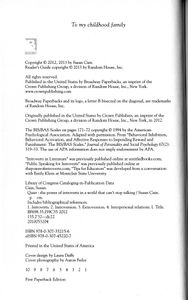
| Copyright Holder | Susan Cain, Random House, Inc. |
| First Published by | Crown Publishers |
| About/Subject | Psychology & Psychiatry—Personality, Introverts, Introversion, Extroversion, Interpersonal relations |
| Cover/Jacket Design by | Laura Duffy |
| Cover photo | Aaron Fedor |
| Format | Paperback |
| Language | English |
| Location | United States of America |
| Copyright | 2012 |
| Copyright | 2013 |
| Pages / Font | 354 pages |
| ISBN 13 | 978-0-307-35215-6 |
| Barcode (EAN) | 9780307352156 |
| EAN 5 | 51600 |
| Library of Congress Classification Number | BF698.35.159C35 2012 |
| Dewey Decimal Classification Number | 155.2'32-dc22 |
| Library of Congress Catalog Card Number | 2010053204 |
| Printer's Key | 10 9 8 7 6 5 4 3 2 1 |
| Price | U.S. $16.00 |
| Price | $18.00 CAN |
| Chapters | Author’s Note
Introduction: The North and South of Temperament
Part One: The Extrovert Ideal
1. The Rise of the “Mighty Likeable Fellow”: How Extroversion Became the Cultural Ideal
2. The Myth of Charismatic Leadership: The Culture of Personality, a Hundred Years Later
3. When Collaboration Kills Creativity: the Rise of the New Groupthink and the Power of Working Alone
Part Two: Your Biology, Your Self?
4. Is Temperament Destiny?: Nature, Nurture, and the Orchid Hypothesis
5. Beyond Temperament: The Role of Free Will (And the Secret of Public Speaking for Introverts)
6. “Franklin Was a Politician, but Eleanor Spoke Out of Conscience”: Why Cool Is Overrated
7. Why Did Wall Street Crash and Warren Buffett Prosper?: How Introverts and Extroverts Think (And Process Dopamine) Differently
Part Three: Do All Cultures Have an Extrovert Ideal?
8. Soft Power: Asian-Americans and the Extrovert Ideal
Part Four: How to Love, How to Work
9. When Should You Act More Extroverted Than You Really Are?
10. The Communication Gap: How to Talk to Members of the Opposite Type
11. On Cobblers and Generals: How to Cultivate Quiet Kids in a World That Can’t Hear Them
Conclusion: Wonderland
A Note on the Dedication
A Note on the Words Introvert and Extrovert
Acknowledgments
Notes
Index
Extra Libris Author’s Note
Introduction: The North and South of Temperament
Part One: The Extrovert Ideal
1. The Rise of the “Mighty Likeable Fellow”: How Extroversion Became the Cultural Ideal
2. The Myth of Charismatic Leadership: The Culture of Personality, a Hundred Years Later
3. When Collaboration Kills Creativity: the Rise of the New Groupthink and the Power of Working Alone
Part Two: Your Biology, Your Self?
4. Is Temperament Destiny?: Nature, Nurture, and the Orchid Hypothesis
5. Beyond Temperament: The Role of Free Will (And the Secret of Public Speaking for Introverts)
6. “Franklin Was a Politician, but Eleanor Spoke Out of Conscience”: Why Cool Is Overrated
7. Why Did Wall Street Crash and Warren Buffett Prosper?: How Introverts and Extroverts Think (And Process Dopamine) Differently
Part Three: Do All Cultures Have an Extrovert Ideal?
8. Soft Power: Asian-Americans and the Extrovert Ideal
Part Four: How to Love, How to Work
9. When Should You Act More Extroverted Than You Really Are?
10. The Communication Gap: How to Talk to Members of the Opposite Type
11. On Cobblers and Generals: How to Cultivate Quiet Kids in a World That Can’t Hear Them
Conclusion: Wonderland
A Note on the Dedication
A Note on the Words Introvert and Extrovert
Acknowledgments
Notes
Index
Extra Libris Show all ▾ |
| Notes | Cover is debossed and varnished. Includes Extra Libris material. |
Added by JT_X