| Form Factor | Desktop |
| Signal Path | Analog Hardware |
| Dimensions | 43.5 × 12.7 × 39 cm (W × H × D) |
| Weight | 13Kg |
| Frequency Response | 20Hz - 20kHz |
| Continuous power output min RMS per channel | 150W RMS |
| Clipping Power | 200W -:®:- Dynamic headroom +4dB |
| RIAA response accuracy | ±0.5dB |
| Damping Factor [8 ohms, 50Hz] | > 120 |
| Slew Factor | > 50 Slew Rate > 35V / µsec |
| Input impedance R | 20kohms, C = 820 pF |
| Input sensitivity [ 1W out / rated power ] | 90mV / 1.1V -:®:- Voltage Gain 32 x [ 30dB ] |
| Signal to Noise Ratio [ 1W / 150W, A-weighted ] | 100 / 122dB |
| Bridged Monophonic MODE : Continuous power [ min RMS per channel 20Hz - 20kHz less than rated distortion ] | -:®:- 8 ohms 1200W RMS -:®:- 4 ohms 1600W -:®:- Dynamic headroom +5dB |
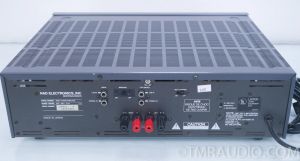
| Notes | High Current for Low Impedance - Many loudspeakers have a complex impedance curve that is lower than 8 ohms at some frequencies. The lower and more complex the impedance, the more output current the amplifier must deliver. A special rear panel switch optimizes NAD amplifiers for 8 ohms or for low impedances [ 2 - 6 ohms ].
Adaptive Soft Clipping - NAD premiered the use of Soft Clipping in solid state amplifiers, gently rounding off waveform corners when the amplifier is overdriven. This eliminates any harsh power-supply buzz and high-order distortion. |