| Model ID | PE: (Power Envelope) |
| Signal Path | Analog Hardware |
| Dimensions | 420 x 108 x 380mm |
| Weight | 6.7 Kg |
| Power | Power consumption (120 ~ 240V, 50/60Hz) - 230VA |
| Frequency Response | 20Hz to 20kHz |
| PRE-AMP | ---------------- (Specification) |
| Phono Input |
| Input impedance (R and C) | 47kΩ / 100pF |
| Input sensitivity, (1kHz, ref. rated power) | 3.2mV |
| Signal/Noise ratio (A-weighted with cartridge connected) | 76dB ref. 5mV |
| THD (20Hz - 20kHz) | <0.04% |
| RIAA response accuracy (20Hz - 20kHz | ±0.5dB |
| Line level inputs |
| Input impedance (R and C) | 15kΩ / 100pF |
| Input sensitivity (ref. rated power) | 160mV |
| Maximum input signal | >10V |
| Signal/Noise ratio (A-weighted ref 1W) | 88dB |
| Frequency response (20Hz - 20kHz) | ±0.5dB |
| Infrasonic filter | -3db at 15Hz, 24dB/octave |
| THD | 0.01% |
| Line level outputs |
| Output impedance | Pre-amp 600Ω - Tape Source Z + 1kΩ - Phones 220Ω |
| Maximum output level | 12V - Tape 8V - Phones >10V into 600Ω >500mV into 8Ω |
| Tone controls |
| Treble | ±7dB at 10kHz |
| Bass | ±10dB at 50Hz |
| Bass EQ | +3dB at 70Hz and +6dB at 40Hz |
| POWER-AMP | ---------------- (Specification) |
| Continuous output power into 8Ω * | 40W (16dBW) |
| Rated distortion (THD 20Hz - 20kHz) | 0.03% |
| Clipping power (maximum continuous power per channel) | 50W |
| IHF Dynamic headroom at 8Ω | +6dB |
| IHF dynamic power (maximum short term power per channel) | 8Ω 160W (22dBW), 4Ω 200W (23dBW) & 2Ω 250W (24dBW) |
| Damping factor (ref. 8Ω, 50Hz) | >50 |
| Input impedance | 22kΩ / 880pF |
| Input sensitivity (for rated power into 8Ω) | 1V |
| Frequency response | 6Hz - 50kHz +0, -3dB |
| Signal/noise ratio | ref. 1W 100dB, ref. rated power 116dB |
| THD (20Hz - 20kHz | <0.03% |
| Notes | According to a long-established industry custom, the highest-quality parts and most highly refined designs are found only in separate audio components - in preamps, power amplifiers, and tuners. Integrated amplifiers usually arc made to a less exalted standard, while all-in-one stereo receivers are regarded as mid-fi products suitable only for first-time buyers.
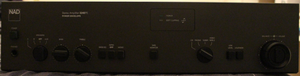
But not at NAD. Whether you choose the flexibility of separates, the convenience of an integrated amplifier, or the economy of a receiver, all NAD audio components share a single design philosophy. Often the very same highly-refined circuits are used in both separates and combination products. For example, the NAD 3240PE integrated amplifier contains the best-buy 2240PE power amplifier, combined with preamplifier and control circuits similar to those in the 1240PE preamp. The 3240PE costs only a little more than other “medium-power” amplifiers, but its no-frills exterior conceals a powerhouse of advanced design. Its high-current output stage delivers full output to loudspeakers of any impedance (even as low as 2 ohms), producing peak currents up to 25 amperes for precise dynamic control of speaker voice-coil motion.
The 3240PE is conservatively rated to deliver 40 watts of continuous power per channel into either 8 or 4 ohms, but i t s Power Envelope design yields extraordinary reserves of tone-burst power for music. With +6 dB of dynamic headroom, the 3240PE delivers over 160 watts per channel at 8 ohms (200 watts/ channel at 4 or 2 ohms) for the high-level transient peaks in today’s wide-range recordings. And the 3240PE puts out 100 watts per channel of clean, clear power for the full 200-millisecond duration of the notes and chords of a grand piano, symphony orchestra, or large jazz band.
The preamplifier section of the 3240PE is based on the 1240PE’s outstandingly quiet, wide-range phono stage. It features precise RIAA equalisation, very low noise, and ample headroom to accommodate the highest-level peaks without distortion. The dynamic range o f the phono preamp circuit exceeds 100 dB. Bass EQ provides solid, subwoofer-like reinforcement of the low bass, extending the useful response of most loudspeakers an extra half-octave lower. It strengthens the fundamental tones of pipe organ, bass drum, and synthesizer with no boomy mid bass emphasis. The Bass EQ circuit rolls off sharply below 30 Hz to avoid woofer damage and minimise unwanted cone-flapping caused by note-musical signals such as LP disc warps.
NAD’s unusually useful tone controls provide musically effective corrections at very low and high frequencies without altering the amplifier’s fundamentally neutral midrange sound.
Preamp Out and Main In jacks make it easy for you to upgrade your audio system by adding an equaliser, a surround-sound processor, an electronic crossover, or another power amplifier.
NAD amplifiers are praised around the world for their advanced engineering, modest pricing, uncomplicated controls, and state-of-the-art sonic performance. For accuracy, freedom from noise and distortion, and supremely musical sound quality, the 3240PE is unmatched in value. It has power reserves to drive the finest loudspeakers with ease, and it will do justice to the finest recordings. |