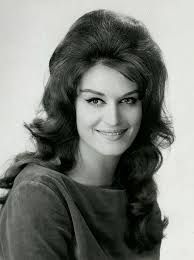
Iolanda Cristina Gigliotti, professionally known as Dalida (Arabic: داليدا), was a French singer and actress, born in Cairo, Egypt to Italian parents. She won the Miss Egypt beauty contest in 1954 and began a 31-year singing career in 1956, selling 170 million albums and singles worldwide.
On 25 December 1954, Dalila left Egypt for Paris.
On 9 April 1956, Dalida participated in the singing contest Les Numéros 1 de Demain, performing Etrangère au Paradis. Prior to the competition, Eddie Barclay, owner of the largest producing house in France, Barclay, and Lucien Morisse, artistic director of the newly established radio station Europe n°1, met in Bar Romain (now Petit Olympia) and discussed what to do that evening. Barclay wanted to watch a film, whereas Morisse wanted to attend the competition, which was being held at Olympia, then the largest venue in Paris. They settled their disagreement by playing 421, a dice game, which Morisse won. Together with their friend Coquatrix, they were greatly impressed after Dalida won the contest and arranged a meeting with her. That event was later perpetuated in biopics and books and became regarded as fateful for Dalida's career. The three men went on to play a large part in launching her career.
Her first song "Madona" was recorded in June and was first released in August on EP with three other songs. "Madona" was played on 28 August 1956 on Radio Europe n°1, which was Dalida's first radio appearance. The record achieved sufficient success and was followed by second EP Le Torrent a month later which received an equally encouraging welcome. Dalida continued performing live throughout the latter part of 1956, while her promoters worked on developing a song that would make her a star; Morisse asked lyricist Jacques Larue to write a French-language version of "Guaglione", the winning song of recent fifth Festival di Napoli, which would become Bambino.
Dalida toured extensively in 1959, playing sold-out dates in France, Egypt, Italy, and Germany. As her fame spread outside France, she started to record songs in other languages to cater for these new audiences. In February, during a TV appearance, she performed her recent version of "Hava Nagila". On 2 March, Minister of information awarded her, alongside Yves Montand, with the Bravos du music hall, the most prestigious music award in France, for the most popular singer in France. During the summer, she covered her own recordings "Ne joue pas" and "C'est ça l'amore" in Flemish as "Speel niet met m'n hart" and "Ik zing amore", respectively, the only time in her career she sang in Flemish.
During 1961, Dalida issued a set of new Italian songs on Canta in Italiano EP, and also scored several top ten hits internationally such as "Nuits d'espagne" and "Tu ne sais pas". In April she made "Pépé" a number one hit both in Austria and Germany, and "24 mille baisers" separately in Austria and France. She also issued two albums Dalida internationale and Loin de moi. During spring in Italy, Dalida signed with film director Giorgio Simonelli and revived her film career with the first film in which she plays the main role. Originally filmed as Italian movie Che femmina... e che dollari!, it was revoiced and retitled for a French audience as "Parlez moi d'amour", after one of tracking songs. The movie also features several other recordings by Dalida, including posthumously released "Ho trovato la felicità". Contrary to her other previous movies, Che femmina... e che dollari! was not a commercial failure as the moderate gross eventually surpassed the low budget. Rihoit described: "sealing her appearance of the early '60s, since it is also her first colour film, all the power and acting potential that Dalida carries in herself and transmits to the screen is clearly visible".
In June 1965, Dalida recorded "La danse de Zorba", a song from 1964 comedy movie Zorba the Greek, which became her biggest international success since "24 mille baisers" in early 1961. The song once again brought Dalida to seven international charts, entering the top three in six and topping in two countries. Surpassing a million copies, it also earned Dalida two more golden discs; in France, and in Brazil where it was also awarded the Cico Viola award for the best selling record of the year. With daily appearances on television dancing to the song on a Sirtaki, Dalida marked the summer period of 1965 and "La danse de Zorba" received the title of that year's tube de l'ete, alongside Christophe's Aline and Hervé Villard's Capri c'est fini.
With Mama in January 1967, Dalida had success in France and Turkey, and was back on top of Italian charts later the same year. "Ciao Amore, Ciao", written and composed by Tenco, was released alongside as they chose it for their competing song at Sanremo Music Festival. The festival premiered on 26 January and they both separately sang their own version. Under the influence of stage fright and alcohol, Tenco delivered a very bad interpretation while Dalida concluded the evening with an ovation, but eventually, they were eliminated in the first round. The following night ended tragically when Tenco was found dead by Dalida in their hotel room. It was reported that the suicide letter explained how he died by suicide due to elimination, as a protest to the hoax and bribed jury, but the major suspicion emerged how actually the mafia was involved. Although the public did not know anything about their relationship, the event greatly affected Dalida and the next concert in Boulogne-Billancourt scheduled for 31 January was cancelled. The following week on 7 February, she appeared on the TV show Palmares des chansons dedicating her rendition of "Parlez Moi de lui" to Tenco. Wearing the same dress she wore when she found his body, the performance was highly sentimental but she showed nothing of a verging depression. On 26 February, Dalida attempted to take her life, ended up in a hospital and spent five days in a coma. The truth broke out about her engagements with Tenco, leaving her worldwide public stunned. Her career was put on hiatus for three months.
After competing for four months at Canzonissima, then the most popular TV show in Italy, in January 1968 Dalida won with "Dan dan dan" that reached number two in Italy. Dalida also came back to film for her first main role in five years, in Italian romantic drama Io ti amo, acting as stewardess Judy alongside Alberto Lupo. The movie was a minor success, but as it was filmed in colour and several of her new songs appeared in, it provided critically acclaimed music video for her latest Italian chart-topper and gold-certified L'ultimo valzer. After the filming, Dalida embarked upon a two-year-long world tour that extended until early 1970. With more than 300 live performances it was Dalida's longest tour up to that moment and, as a part of it, in summer 1968 she participated in a popular Italian summer festival Cantagiro and won the main prize. In 1969, during the third leg that started on 9 January in Milan, for the first time in career Dalida performed in Yugoslavia and in lower parts of Africa. After Gabon in December and in Tahiti in January 1970, the tour ended in Iran in February.
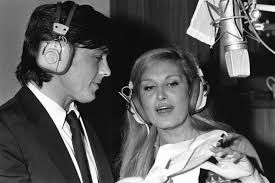
In late 1972, Dalida recorded duet "Paroles... paroles..." with her longtime friend Alain Delon who she picked on her own. Lyrics tell a story of a man offering a woman "caramels, bonbons et chocolat" and repeats "que tu es belle" (how beautiful are you), to what she answers with "paroles, paroles" (words, words) indicating that his words are nothing but hollow. The single released on 17 January with B side "Pour ne pas vivre seul", topped charts in France, Japan, Mexico and Portugal, and had a fair performance is several other countries. Receiving a triple gold certification, it also spawned a dozen of international covers, inspiring foreign singers to record it in their native languages. Dalida and Delon never made together with a TV performance for the song, but Dalida alone did make several TV appearances for it, and during concerts with his voice in playback. In the future decades, "Paroles paroles" went on to become one of the most famous songs in France of all time and a signature track of Dalida. Like that, the expression "paroles, paroles" entered the everyday language and, as Pessis mentioned: "is often used to evoke those who make promises and never hold them".
Very quickly Dalida left disco and started singing slower, moody, deep-minded songs with typical 1980s instruments. It was all caused again by escalating problems in her private life (break up with St. Germain in 1981). That same year, she started to sing more often her 1973 song "Je suis malade" ("I am sick"). Her performances of that song during that year and later on, are today one of her most remembered performances. The song has also become her signature track.
By the beginning of 1984, her personal difficulties escalated again; she could not dedicate as much time to her career as she would have wanted. However, she recorded a new collection of mainly dance songs including "Soleil" and "Kalimba de Luna". In mid-1984, she recorded the album Dali, a collection of all her songs released that year. To promote the album, a television special was later released on VHS named Dalida Idéale; it was filmed in 1984, and directed by the then highly rated Jean-Christophe Averty. It includes Dalida singing in seven languages and dancing her way through a huge number of her earlier hits with the best video effects available at the time and wearing more than 40 outfits from the best French and international fashion designers, maintaining her "Glamour" and "DIVA" trademarks gained during the disco era in the late seventies.
By the beginning of 1987, Dalida was entering into severe depression while trying to overcome it. Although no new songs had been recorded, she toured internationally from Los Angeles to the Middle East. Being part of the music spotlight in 1978, many of her songs appeared daily on TV, as well as many notable TV appearances on talk shows from 1986–1987. Her last live TV appearance was hosting the Nuit des César on 7 March 1987. Her last live performance took place in Antalya, Turkey from 27 to 29 April 1987, just before her suicide. Her performance was not recorded by the national television of Turkey which was the only TV channel in the country.
On the night of 2–3 May 1987, Dalida died by suicide by overdosing on barbiturates. She left behind a note which read, "La vie m'est insupportable... Pardonnez-moi." ("Life is unbearable for me... Forgive me.").