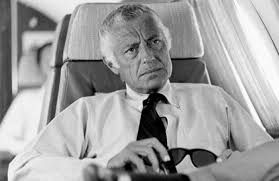
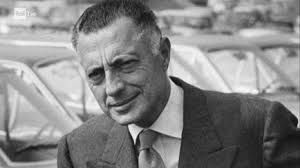
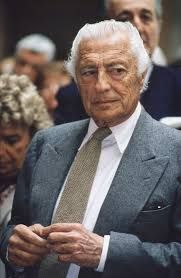
Giovanni Agnelli, known as Gianni, was an Italian entrepreneur and politician, main shareholder and administrator at the top of FIAT, a senator for life, as well as an officer of the Royal Army. He was also known as "the lawyer" because of his degree, the degree in law, although, having never taken the exam as a prosecutor, the title did not belong to him.
Son of Edoardo Agnelli and Virginia Bourbon from Monte dei Principi di San Faustino, he was the second of the couple's seven children.
Born in Turin in the family home in Corso Oporto (now Corso Matteotti), Gianni Agnelli was the grandson of the homonymous senator Giovanni Agnelli. His father Edoardo died tragically in a plane crash in 1935, when Gianni was 14 years old. Married in 1953, in Strasbourg, in the castle of Osthoffen, Marella Caracciolo dei Principi di Castagneto, with whom he had two children, Edoardo and Margherita.
Taking office at the helm of Fiat at the age of 45, after having practically played only representative roles, Gianni Agnelli found himself faced with two problems. The first concerned the execution of the agreement with the Soviet Union for the construction of an industry in a town on the Volga (which will be called Togliatti), for which Fiat had to supply Autoprominport (the Soviet body in charge) turnkey plant and production know-how. The contract had been Valletta's last work and his death in 1967 risked making implementation difficult, but the management was not particularly onerous: the Soviets respected the established terms and everything proceeded according to the established program .
Based on a study commissioned to an American consultancy company, from the beginning of 1968 he started a complex work of redesigning the corporate system, entrusted above all to the intervention of the new CEO, his brother Umberto Agnelli (born in 1934). The latter, who had sat on the Fiat Board of Directors since 1964, derives from a previous experience of reorganization of the French subsidiary Simca, at the time the fourth car manufacturer on the French market. By renouncing Vittorio Valletta's industrial policy (Earth / sea / sky), Gianni Agnelli decides to get rid of those productions that require continuous investments and whose profitability is precarious and conditioned (not only on the Italian market) by choices often linked to character decisions politic. 50% of Grandi Motori, known as the Sea Division, specializing in marine diesel engines for large ships, is transferred to Finmeccanica, which will be transferred to Trieste with the initial name of Grandi Motori Trieste.
The conflicts of Gianni Agnelli's FIAT with Italian trade union forces are an example of the relationship between the world of industrialists and trade unions in the 1980s.
At the beginning of the 2000s, Gianni Agnelli, convinced that Fiat will not be able to face the challenge of the world market on its own (between 1990 and 2001 the FIAT market share in Italy decreased from around 53% to around 35% and in Europe from slightly more than 14% to less than 10%), opens to the Americans of General Motors (GM), with whom they conclude an agreement: the large US company buys 20% of Fiat Auto by paying it with own shares (a capital increase reserved for Fiat) which are worth approximately 5% of the entire GM capital and Fiat obtains a put clause, the right that can be exercised in this case after two years and within the following eight years, to sell the remaining 80% of Fiat Auto to GM at a price to be determined with certain predefined criteria and that GM will be obliged to purchase. Mergers are also planned between companies set up by Fiat Auto plants and Opel plants, GM's European subsidiary, based in Germany.
The agreement is broken five years later (both FIAT and GM are in great difficulty) with a result opposite to what was originally assumed: it is not the Fiat Auto that is entirely sold to GM, but GM that pays to avoid the exercise of the right of sale (put clause) by Fiat, also transferring the GM shares of Fiat Auto to the latter. The mixed operating companies, already established and operating, are dissolved and each one takes back his part, even if GM retains the production rights of the MultiJet engines, which will be mounted on the entire GM range and built in a special GM-Powertrain plant in Tychy, Poland. The economic crisis in the Fiat Group auto sector finds Agnelli already struggling with cancer and he can now only participate in a limited way in the development of events.
On January 24, 2003 Gianni Agnelli died, at the age of 81, in Turin in his historic hillside residence Villa Frescòt (on the border with Pecetto Torinese) for prostate cancer. The burning room is set up in the Pinacoteca del Lingotto, according to the Senate ceremony. The funeral, broadcast live on Rai 1, takes place in the Cathedral of Turin, followed by a huge crowd.