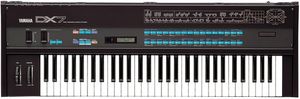
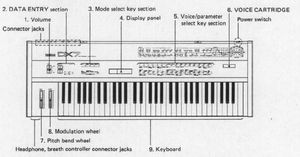
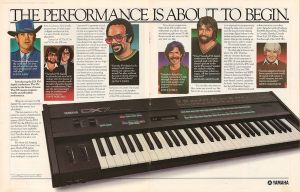
| Notes | The Yamaha DX7 is a phase modulation based digital synthesizer manufactured by the Yamaha Corporation from 1983 to 1989. It was the first commercially successful digital synthesizer
Tone generation in the DX7 is based on linear phase modulation synthesis, officially euphemised as frequency modulation (FM), which was developed based upon research by/licensed from John Chowning at Stanford University. This uses multiple sine wave oscillators, which can modulate each other in various configurations offered as 32 "algorithms", thus generating a wide variety of possible harmonic and inharmonic spectra. The DX7 was known for the precision and flexibility of its bright, digital sounds, which could be clearer and less linear than those of the subtractive analog synthesizers that preceded it. The DX7 is well known for its electric piano, bells, and other "struck" and "plucked" sounds which emphasize complex attack transients. Phase modulation as used in this and later synthesisers is capable of generating a wide range of both imitative and purely synthetic sounds.
The DX7 is capable of 16-note polyphony. It is monotimbral, but the sound of a single DX7 patch can change either subtly or wildly along the length of the keyboard or when played with different velocities, thus approximating multitimbrality.
Three improved models classed as the DX7 II family were released between 1987 and 1989, all of which featured updated internal circuitry and a restyled case. These were, in ascending order of number of features:
the DX7s (single), which increased the internal patch memory, considerably improved the implementation of MIDI, and improved output sound fidelity from the mark I's 12-bit floating point DAC + 2 bits of analogue companding (equivalent to 14 bits of dynamic range but not signal-to-noise ratio) to a full linear 15 bits (a 16-bit DAC with the least significant bit tied off, nonfunctional)
the DX7 II D (Dual timbres/outputs), which was equivalent to a DX7s + stereo outputs, bi-timbrality, and a larger screen, and
the DX7 II FD (Floppy Drive), which was identical to the DX7 II D except that it also added a floppy disk drive. |