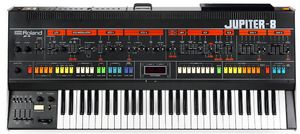
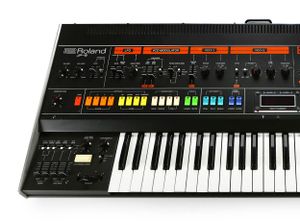
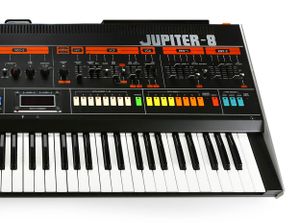
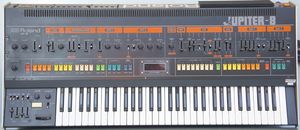
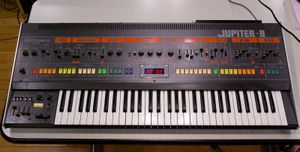
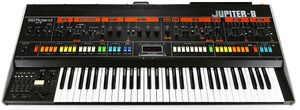
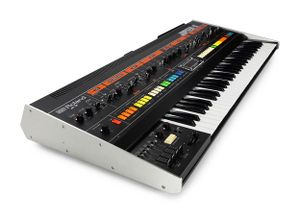
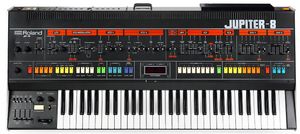
| Notes | The Jupiter-8 is an 8-voice polyphonic analog synthesizer. Each voice features two VCOs with cross-modulation and sync, pulse-width modulation, a non-resonant high-pass filter, a resonant Low-pass filter with 2-pole (12 dB/octave) and 4-pole (24 dB/octave) settings, an LFO with variable waveforms and routings, and two envelope generators (one invertible).
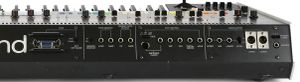
Features include adjustable polyphonic portamento and a Hold function for infinite sustain of notes and arpeggios. A versatile arpeggiator can be synchronized with external equipment by using the proprietary Roland DCB interface, clock input via CV jacks on the rear panel, or one of the aftermarket MIDI kits from Encore or Kenton. An assignable bender can be used to control pitch or filter frequency.
From the factory, the JP-8 could store 64 patches. Patches could be stored to, or loaded from, a standard analog tape/cassette. The Encore JP8MK MIDI kit doubles the patch memory to 128 and enables the JP-8 to store and recall patches over a MIDI connection, using a computer with sysex utility software.
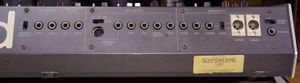
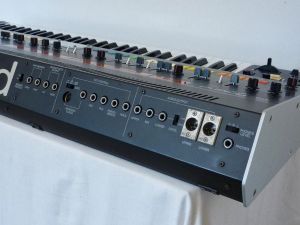
The Jupiter-8 includes balanced stereo XLR outputs as well as unbalanced 1/4" outputs. In addition to monophonic and polyphonic modes, the Jupiter-8 includes a unison mode, in which all 16 oscillators can be stacked into a single monophonic patch.
Throughout the production of the JP-8 there were several changes. Starting at serial #171700 the D/A converter on the Interface board was changed from 12-bit to 14-bit. This change was made mainly to improve tuning stability. The problem with the 12-bit digital-to-analog converter on the original JP-8 is that it could cause the autotune to be inaccurate in some instances. Some say to avoid these early JP-8's while others say they haven't experienced tuning problems. Starting at serial #242750 the LEDs of the display were changed to brighter ones. Starting at serial #282880 the JP-8 came standard with a DCB port. These newer JP-8's may be referred to as JP-8A's. DCB, or Digital Control Bus, was Roland's pre-MIDI interface that allowed the JP-8 to talk to other DCB enabled hardware, such as the Roland MC-4 and MC-8 microcomposers. Previous JP-8's had the option of having the OC-8 retrofit installed to give it DCB capability. |