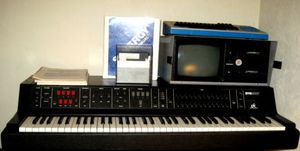
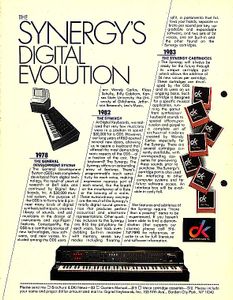
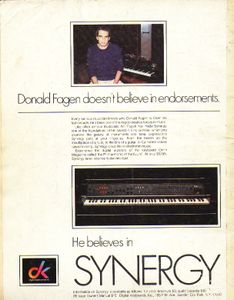
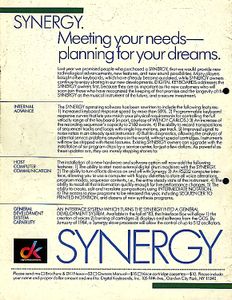
| Notes | Further work on the same basic concept produced the lower-cost Synergy, released in 1981.[10] The Synergy removed the computer component, and re-packaged the entire system into a case with a 77-key keyboard. Another additive synth reached the market at about the same time, the Con Brio ADS200, at the slightly lower price of $20,000. Neither the Con Brio or GDS sold well, while the Synergy managed to find some market share. However, when the famous Yamaha DX7 was released in 1983, it quickly took over the market. The DX7's FM synthesis offered the same basic control over output sound as an additive synth, but could duplicate the effects of many ganged oscillators in as few as two.[11] Its $2,000 price point eliminated any competition from the additive synths. Production of the Synergy ended in 1985.
A final version of the original machine was produced after Digital Keyboards was shut down in early 1985. Digital Keyboards' chief designer, Mercer Stockell, decamped and formed Mulogix with Jim Wright and Jerry Ptascynski. The Mulogix Slave 32 was a Synergy re-packaged into two rack-mount modules with a MIDI interface. The Slave 32 could read and write EPROM cartridges from the Synergy.[12] |