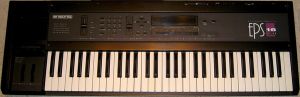
| Notes | Polyphony - 12 voices at 52 kHz.
16 voices at 39 kHz.
20 voices at 31.2 kHz.
Multitimbral - 8 parts.
Filter - Independent dynamic digital filter per wavesample, multi-mode digital low pass or variable-width band-pass with many slopes
VCA - 6-stage envelope including envelope preset templates
Sequencer - 8 tracks with separate instrument, volume, and MIDI channel. 80,000 notes limit.
Keyboard - 61 keys (velocity and aftertouch)
Memory - 512 Kb (480 Kb to be exact) internal (expandable to 896 Kb w/ 2x expander, 2.1 Mb w/ 4x expander)
Control - MIDI, Disk Drive (800K double-sided 3.5" micro-floppy), SCSI (w/ 4x+SCSI expander)
Weight - 29 pounds (13 kilograms)
Date Produced - 1988
The EPS uses MIDI and can be used as a controller of other instruments, or linked to a PC or Macintosh.
The EPS was eventually superseded by the EPS 16+ which upgraded the sample-size to 16-bits and added a 24-bit effects system. Other improvements included CD-ROM support in the optional SCSI interface and FlashBank storage for the OS and favourite sounds.
The EPS and EPS 16+ were both succeeded by the Ensoniq ASR-10 which was able to read EPS samples and disks.
Ensoniq EPS-16+, released in 1991. The EPS-16+ was very similar to the EPS. Its main addition was integrated DSP effects and stereo audio routing. Due to the upgrade to 16-bit audio, the Output Expander on the 16plus was different, instead providing three pairs of stereo outputs, two from before the new effects chip. |