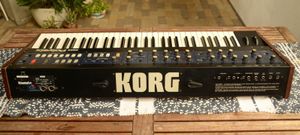
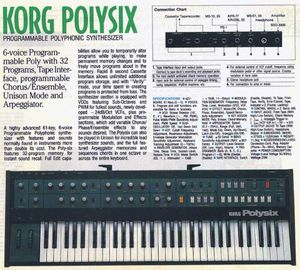
| Connections | - FROM TAPE · 1/4" Phone Jack (6.35mm) · Mono, Unbalanced, Socket (Female)
- TO TAPE · 1/4" Phone Jack (6.35mm) · Mono, Unbalanced, Socket (Female)
- CHORD MEMORY · 1/4" Phone Jack (6.35mm) · Mono, Unbalanced, Socket (Female)
- ARPEGGIO TRIG IN · 1/4" Phone Jack (6.35mm) · Mono, Unbalanced, Socket (Female)
- VCF fcM IN · 1/4" Phone Jack (6.35mm) · Mono, Unbalanced, Socket (Female)
- HEADPHONES · 1/4" Phone Jack (6.35mm) · Stereo, Socket (Female)
- OUTPUT · 1/4" Phone Jack (6.35mm) · Mono, Unbalanced, Socket (Female)
|
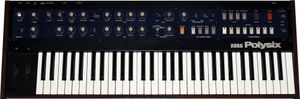
| Notes | The Korg Polysix is a six voice programmable polyphonic analog synthesizer released by Korg in 1981.
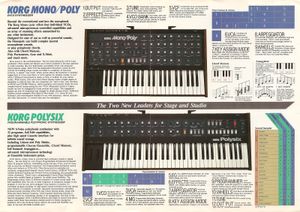
The synthesizer's main features are six-voice polyphony (with unison and chord memory voice assignment modes), 32 memory slots for patches and cassette port for backing up patches, and an arpeggiator.
On its release it was, along with the Roland Juno 6 which was released around the same time, one of the first times a polyphonic analog synthesizer was available at a cost effective price 'for the masses'. It cost about twice as much as the competing Juno 6 but had far more features and 'real' VCOs in place of the Juno's DCOs. It also had on-board patch storage and back up which the cheaper Juno lacked until the upgraded Juno 60 model.
Korg developed the Polysix with an eye on the Sequential Circuits Prophet 5, trying to provide some of the features found on the more expensive synth in a compact, reliable and much cheaper design. While not as powerful, it used SSM2044 4-pole voltage-controlled, giving the Polysix a warm, rounded and organic sound.
Although the Polysix only had one oscillator per voice, it also featured built in chorus, phaser and 'ensemble' effects (using a 'bucket brigade' analog delay line design), to provide a fuller sound.
Polyphony - 6 Voices
Oscillators - 1 VCO per voice (saw, PW, PWM) + 1 sub-oscillator per voice
LFO - 1 LFO assignable to VCA,VCF or VCO
Filter - Low-pass only, self-oscillates at high resonance. ADSR envelope for VCF (filter).
VCA - VCA uses filter's ADSR envelope or simple gate on-off
Effects - Chorus, phaser, ensemble
Memory - 32 patches
Keyboard - 61 keys
Arpeg/Seq - Arpeggiator (Up, Down, Up/Down, Latch; Full, 2-oct, 1-oct; rate 0.2 to 20 Hz)
Control - Chord memory, Arpeggiator sync in, CV input for filter cutoff.
Date Produced - 1981 |