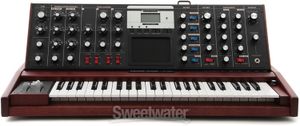
| Notes | The MINIMOOG VOYAGER SELECT SERIES Synthesizer is a customizable version of the VOYAGER Electric Blue in which the customer can choose between mahogany, electric blue, traditional ash, white wash, maple, black, cherry, and walnut cabinets with red, blue, white, orange, green, or purple backlighting. They listed for $3,659 but were reduced to $2,999 when discontinued in 2013.
It's a monophonic (one note at a time) analog performance synthesizer that incorporates virtually all of the sound resources and functions of the original Model D Minimoog, which was produced by Moog Music, Inc. from 1970 to 1982. It has many new additional features, including a three dimensional touch surface, MIDI IN and MIDI OUT implementation, extensive patching facilities, and a large number of new panel features.
The signal path starts with a bank of three wide-range, high-stability voltage controlled oscillators, one noise source, and one audio preamplifier for externally-applied audio signals. The sound modifiers are two Moog filters and one stereo VCA (Voltage Controlled Amplifier). Modulation sources are two ADSR (Attack Decay Sustain Release) envelope generators and one multiwaveform LFO (Low Frequency Oscillator).Control devices include a 44-key keyboard with velocity and afterpressure outputs, pitch bend and modulation wheels, a three dimensional touch surface, and many control/pedal input jacks.
The MINIMOOG VOYAGER has a hinged, multi-position panel and a solid hardwood cabinet. The power supply accepts any power voltage from 100 volts to 240 volts.
Oscillators Module
Three wide-range, high stability VCO's (Voltage Controlled Oscillators) with continuously-variable waveforms.
* FREQUENCY controls (2) vary the frequencies of Oscillators #2 and #3 over a +/-7 semitone range with respect to Oscillator #1.
* OCTAVE selectors (3) set the frequency ranges of the oscillators in six octave steps.
* WAVE controls (3) provide continuous control over the waveforms of the oscillators, from triangular, to sawtooth, to square, to narrow rectangular.
* 1-2 SYNC switch synchronizes the Oscillator #2 waveform to the frequency of Oscillator #1, for dramatic timbral effects.
* 3-1 FM switch provides linear frequency modulation of Oscillator #1 by Oscillator #3.
* 3 KB CONT switch disconnects Oscillator #3 from control by the keyboard, thereby enabling it to function as a drone.
* 3 FREQ switch lowers the frequency of Oscillator #3 into the sub-audio range, thereby enabling it to function as a low frequency audio or modulating oscillator.
Mixer Module
Five-input mixer for combining the audio sources prior to filtering.
* Input Level controls (5) adjust the relative levels of the oscillator, noise, and external audio input signals.
* Input switches (5) enable the player to quickly switch individual audio signals in and out.
* External Level LED enables the player to set the correct external audio signal level.
Filters Module
Dual mode filter module includes dual lowpass and highpass-lowpass filtering. Dual lowpass mode consists of two Moog lowpass-resonant filters in parallel, one per output channel. Highpass-lowpass mode consists of Moog lowpass filter in series with a highpass filter.
* CUTOFF control sweeps the frequencies of both filters throughout the audio range.
* SPACING control sets the spacing between the frequencies of the two filters, over a +/-3 octave range.
* RESONANCE control adjusts the resonance of both filters, from none (pure lowpass response) to filter oscillation.
* KB CONT AMOUNT control sets how much the filters open and close as the player presses different keys on the keyboard.
* Dual Lowpass/Highpass-Lowpass switch selects between dual lowpass operation or highpass-lowpass operation.
Envelopes Module
The Envelopes Module generates two wide-range ADSR (Attack Decay Sustain Release) envelopes. The Filter Envelope sweeps the filter and is available for modulation shaping. The Volume Envelope shapes the overall volume.
* ATTACK controls (2) determine the attack times of the envelopes.
* DECAY controls (2) determine the decay time constants of the envelopes.
* SUSTAIN controls (2) determine the sustain levels of the envelopes.
* RELEASE controls (2) determine the release time constants of the envelopes.
* AMOUNT TO FILTER control determines how much the filter envelope will open and close the filter, from full negative (inverted envelope) to full positive (non-inverted envelope).
* ENVELOPE GATE SWITCH selects whether the envelopes will be triggered by the keyboard, on , or by an externally-applied gate.
LFO Module
Low Frequency Oscillator generates triangular, square, Sample & Hold, and smoothed Sample & Hold waveforms for use as modulating signals.
* RATE control sets the LFO rate over the range 0.2 Hz (one cycle every five seconds) to 50 Hz (fifty times a second).
* SYNC selector selects LFO synchronization source to be from the keyboard gate, external envelope gate, external gate, or off (no synchronization).
* RATE LED provides visual indication of the LFO rate.
Modulation Busses Module
Selects the sources, destinations, and shaping signals for the MOD WHEEL bus and the EXT PEDAL/ON bus.
* SOURCE selectors (2) selects the modulation source from the LFO triangle or square waveforms, Oscillator# 3, sample and hold, the external modulation input (MOD2) or noise.
* DESTINATION selectors (2) selects the modulation destination from all the audio oscillators, just Oscillator #2, just Oscillator #3, the filter cutoff frequencies, the oscillator waveforms, or LFO Rate.
* SHAPING selectors (2) selects the key pressure signal, filter envelope, note-on velocity or on to shape the modulation signal on that bus.
* AMOUNT controls (2) sets the overall modulation amount for each bus. |