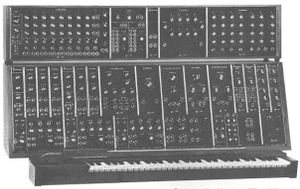
| Notes | Solid walnut cabinets housing smaller dedicated function “modules” which, when interconnected by patch cables, can be used to create, shape and manipulate electronic sounds into musical bliss. This modular approach allowed buyers to configure the systems to meet their needs or their budgets. In addition to custom configurations, Moog Music also offered pre-configured systems in a variety of models.
The Moog modular synthesizers use the 900-series of modules. These modules, many of them designed entirely by Robert Moog, are examples of analog synthesis at its finest. The modules are actually quite musician-friendly with straight forward input and output jacks and clearly labeled knobs. There are no technical electronic diagrams silk-screened all over them or esoteric controls. They were very easy to grasp conceptually, making them perfect candidates for music labs and professional musicians alike.
The voltage-controlled oscillator modules produce stunning tones with only one real drawback...drift. Revised VCO modules (the 921-series) were eventually released that offered more stable tuning. But the legend of the Moog sound truly comes from the 24 dB/oct lowpass filter (the 904A). To this day, no one has come close to improving upon the original Moog filter and its patented ladder design. Additional modules include VCAs, envelope generators, highpass filters, equalizers, noise generators, a sequencer, and utilitarian modules such as audio mixers, control voltage processors and power supplies. There is no dedicated LFO module, however. Instead, one of the VCO modules has a rate slow enough (0.1 Hz) that it can be used as an LFO instead of a sound source. |