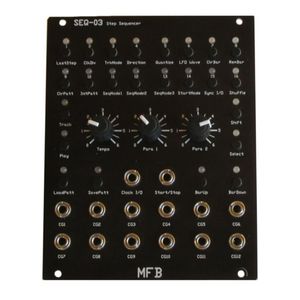
| Notes | MFB's SEQ-03 unites the functionality of both predecessors SEQ-01 and SEQ-02 in a new step-sequencer with several additional functions. There are four track types now: CV, Gate, AD-envelope and LFO. The latter type offers a wave form selection of ascending saw tooth, descending saw tooth, sine and square curves.
There are two programmable parameters per step. In addition, the running direction of the sequence for every track can be individually set to Up, Down, Up/Down or Random. In addition, the shuffle-mode was fine-tuned and now offers an adjustable intensity in 15 steps.
Three operating modes for different applications.
Mode 1 allows a maximum of four bars per pattern, with a total length of up to 64 steps. Here, the number of steps and the clock-divider is equal for all tracks.
Mode 2 allows working with a fixed pattern length of 1 bar. Instead, the number of steps and the clock-divider can be set per track. Consequently, this mode allows creation of polyrhythmic patterns.
Mode 3 was adapted from SEQ-02, offering six CV- and Gate-tracks each. Here, the gate parameter is always set along to the CV programming.
In operating modes 1 and 2, each track can be used as either CV-, Gate-, LFO- or AD-envelope. The rotary controls Para1 and Para2 adjust the following functions:
CV: Para1 adjusts the CV-value, Para2 the glide-value
Gate: Para1 adjusts the gate-intensity, e.g. to control the level of MFB drum modules. Para2 sets the gate-length
AD-envelope: Para1 adjusts the attack time, Para2 the decay time
LFO: Para1 adjusts the speed, Para2 the LFO's amplitude
SEQ-03 can either run in sync to an internal or external clock signal. By using the internal clock reference, the clock-output as well as the start/stop output may be used to synchronize and control other modules. If using an external clock reference, the same jacks serve as inputs.
The SEQ-03 is no longer specialized to control drums only. Most modular systems offer multiple options for useful utilizations of trigger impulses, such as control over sample & hold, switches, clock-dividers, sequencers, logic modules or envelopes. Typically, continuous clock signals are used as trigger-signals, e.g. to control S&H or clock-dividers. However, SEQ-3 allows rhythmic triggering, resulting in immediate "rhythmization". Thanks to its large number of CV- and Trigger-tracks, the SEQ-03 will almost always have a few tracks left to dedicate to special tasks beside the main drum tracks. |