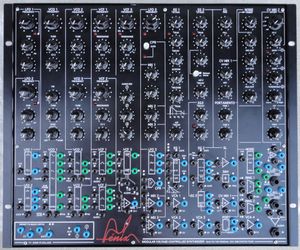
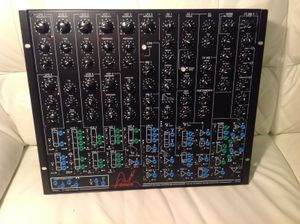
| Notes | A direct descendant of the highly respected Synton 3000 modular synthesizer and the Syrinx lead synth, the Fenix offers traditional analog technology and innovative new features in a compact design
Concept
We have designed a unit with a fixed set of separate modules, that need to be interconnected like a modular (like an Korg MS50 or Roland 700).
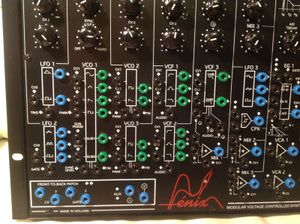
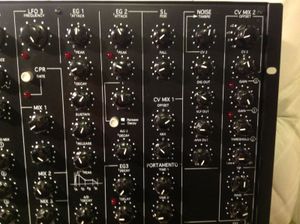
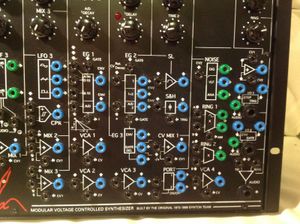
There are 65 rotary controls at the upper half of the front panel and about 140 banana-sockets at the lower half. The unit is about 5 in deep, 19 in wide (rack mount, and 9 U high.
Modules:
We decided that rather than creating identical modules, almost every module is different from the others. This means that every LFO and Envelope Generator (and most mixers, VCO's, VCF's etc.) has different controls and in/outs.
There are no Curtis-chips or other hard-to-get components in the unit; only easily available parts.
Interfacing:
The Fenix uses industry-standard 1V/octave for pitch control, and positive gate signals.
Internal audio levels are 4 VPP, control voltages are -4/+4 or 0-8 Volts.
Controls for CV attenuation are marked 'CV2'. There are two types:
0/max regular control and -/0/+ This control has zero in the middle position, Clockwise position attenuates the CV, Anti-clockwise inverts and attenuates the CV.
Refer to front panel picture to see which ones are used for which modules.
Strip 1:
LFO1
Controls: Frequency, CV2, Symetry/PW
Inputs: CV2, trigger
Outputs: Triangle, pulse
LFO2
Controls: Frequency, CV2, Symetry/PW
Inputs: CV2, gate
Outputs: Triangle, Double-frequency triangle, pulse
Strip 2:
VCO1
Controls: Frequency, Tune, CV2, PW, PWM, Sync level
Inputs: CV, CV2, linear FM, sync, sync level, PWM, Sub phase
Outputs: Sine, Saw, Pulse, Sub 1, Sub 2
Strip 3:
VCO2
Controls: Frequency, Tune, CV2
Inputs: CV, CV2, linear FM, PWM
Outputs: Saw, Pulse
VCO3
Controls: Frequency, Tune, CV2
Inputs: CV, CV2, linear FM, PWM
Outputs: Saw, Pulse
Strip 4:
VCF1 (state variable 2-pole filter)
Controls: Frequency, Resonance, CV2
Inputs: CV, CV2, Audio
Outputs: LP, BP, HP
VCF2 (state variable 2-pole filter)
Controls: Frequency, Resonance, CV2
Inputs: CV, CV2, Audio
Outputs: LP, BP, HP
Strip 5:
VCF3 (ladder-type filter)
Controls: Frequency, Resonance, CV2, Audio in 1, Audio in 2, Audio in 3
Inputs: CV, CV2, Audio 1, Audio 2, Audio 3
Outputs: 12 dB (2-pole tap) , 24 dB (actually 5-pole)
Strip 6:
LFO3
Controls: Frequency
Inputs: (none)
Outputs: Sine, triangle, pulse
Comperator
Controls: Momentary push button
Inputs: +, -
Outputs: Gate
Mixer1
Controls: A, B(-/+)
Inputs: A, B, X (unity gain)
Outputs: out
Mixer2
Controls: A-B balance
Inputs: A, B, X (unity gain)
Outputs: out
Mixer3
Controls: A-B balance
Inputs: A, B, X (unity gain)
Outputs: out
Strip 7:
Envelope generator 1
This EG has two different curves, one ADSR and a decay-only curve.
The tPeak control keeps the output at maximum for a controllable time between the attack- and decay-stages.
Controls: Attack, tPeak, Decay, Sustain, Release, Accent
Inputs: Gate, Decay, Peak level, Release, Accent time, Accent level
Outputs: CV out, Accent out
VCA1
All VCA's are suitable for audio-and CV-signals.
Controls: (none)
Inputs: Signal, CV
Outputs: Signal out
VCA2
Controls: (none)
Inputs: Signal, CV
Outputs: Signal out
Strip 8:
Envelope generator 2
This EG has two different curves, one AD / AR and a decay-only curve.
There is also a mix-output that adds the two curves 50/50..
Controls: Attack, tPeak, Decay/Release, Accent. Decay / Release switch.
Inputs: Gate, decay/release, Accent level
Outputs: CV out, Accent out, Mix out
Envelope generator 3
Controls: Delay, Decay
Inputs: Gate
Outputs: CV out, Delay gate out, gate out
VCA3
Controls: (none)
Inputs: Signal, CV
Outputs: Signal out
Strip 9:
Slew Limiter
Can also be used as (sub-audio) lowpass filter, envelope follower or AR envelope generator.
Controls: Rise, Fall
Inputs: in
Outputs: out
Sample & Hold
Controls: (none)
Inputs: In, trigger
Outputs: out
CV mix 1
Controls: Gain, Offset
Inputs: In, X (unity gain)
Outputs: out
Portamento
Controls: Time 1, Time 2
Inputs: In, Enable
Outputs: out1, out2
Strip 10:
Noise generator
The digital noise generator has a cycle period of approx. one year. The clock is a VCO, so you can control the bandwidth using the control or a CV.
Controls: Timbre, CV2, Analog noise level, Digital noise level, VLF level
Inputs: Timbre
Outputs: Analog, Digital, VLF
Ring Modulator 1
This ring modulator has a CV input mixed in with the B-input (the AM input). Use this input for VCA, or combine with the audio-ins as cleanfeed control for ring modulation
Controls: (none)
Inputs: A, B, am
Outputs: DC-coupled, AC-coupled (eliminates offset clicks)
Ring Modulator 2
Controls: (none)
Inputs: A, B
Outputs: Signal out (DC-coupled)
VCA4
Controls: (none)
Inputs: Signal, CV
Outputs: Signal out
Strip 11:
CV mixer2
Controls: Octave switch, CV2
Inputs: CV In (fixed unity gain), CV2
Outputs: CV out
Audio in processor 1
This module is an input-amp for external audio signals. Use it to process other synth sounds, drum-machines and any other sound source.
Controls: Gain
Inputs: Jack
Outputs: Audio out, Level CV, Trigger
Audio in processor 2
Another input amp.
Controls: Gain, Trigger threshold
Inputs: Jack
Outputs: Audio out, envelope, Gate
Audio out module
To interface to the mixer or other sound system. This output will drive headphones as well.
Controls: Tip (left) attenuator, Ring (right) attenuator
Inputs: Tip (left), Ring (right)
Outputs: Stereo Jack
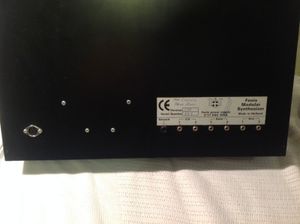
Front to back panel connections:
6 * Banana sockets on the front panel are wired to 6 mini-jacks on the rear of the unit. |