| Notes | Excerpted from The Synthesizer, by Mark Vail:
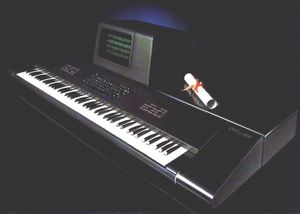
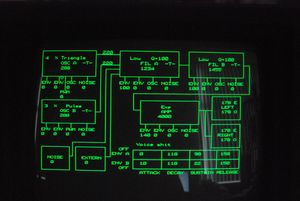
The designer/composer/engineer/visionary David McLey (1947–2010) imagined quite a music system during the late 1970s. After hot-wiring modules in his ARP 2500 for computer control, he envisioned a computerized workstation for composing and recording in his Toronto-based Nimbus 9 studio as well as for use in live performance. Funded by the Canadian entrepreneurial team Hazelcom Industries, McLey and his associates developed the McLeyvier, a machine that combined fifteen analog-synth voice cards, 128-voice polyphony, built-in voice editing, patching, mixing, and music notation—all under the control of a computer running a proprietary integrated operating system. Thanks to a voltage meter installed on each voice card, the master computer auto-tuned and calibrated the analog components.
According to electronic-music composer Laurie Spiegel, who joined the McLeyvier development team in 1982, each voice card was loaded with fifty or more DACs and a multitude of computer-control relays. In total, the McLeyvier had about 800 DACs connected to a DEC PDP 11/23 that had 512K of memory, a pair of 5MB hard drives, a floppy drive for backup, and a Hewlett-Packard plotter for scoring. The khaki-colored McLeyvier weighed about three hundred pounds.
Regrettably, the emergence of digital signal generation and sampling had squelched analog’s popularity, and Hazelcom produced only eight McLeyviers before shutting down the project in 1983. By then the McLeyvier team had developed a digital synthesis board, which proved to be such an excellent multiprocessor that Hazelcom decided they could make more money selling it as a parallel-processing computer for hundreds of thousands of dollars rather than as the basis for a high-end computer-music instrument for $40,000 at the most. |