| Form Factor | Keyboard |
| Signal Path | Hybrid Analog / Digital Hardware |
| Dimensions | W 39.3" (998mm) x D 13.3" (338mm) x H 4" (101mm) |
| Weight | 24 lbs (10.9 kg) |
| Power | AC (31 watts) |
| Keys | 61 (Velocity, Channel Aftertouch) |
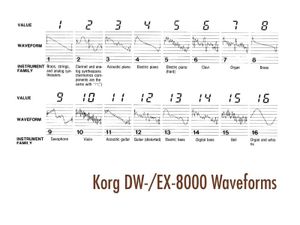
| Waveforms | 16 |
| Digital Wave Generators (DWGS) | 2 per voice |
| LFO | 1 (4 waveforms, can modulate filter or pitch) |
| Filters | Digitally controlled analog low-pass, 24 dB per octave |
| Envelopes | 3 (EG1 VCA: 4 segments + 2 times (ADBSSR); EG2 VCF: 4 segments + 2 times with polarity inversion; 3- AutoBend simple pitch EG (OSC1 / OSC2 or both) 2 modes up / down) |
| Effects | Digital delay with modulation |
| Polyphony | 8 voices (Two Poly and two Unison modes) |
| Arpeggiator | Up, Down, 64-step Custom (Arpeggiator can be synced to external MIDI clock) |
| Memory | 64 patches (8 patches in 8 banks) |
| Memory Expander | MEX-8000 adds 4 additional banks (Optional add-on) |
| Channels | 8 Voice |
| Connections | - Tape Memory in/out · RCA (Phono, Cinch) · Mono
- MIDI in/out/thru · DIN
- Main Outputs L/Mono, R · 1/4" Phone Jack (6.35mm) · Mono
- Headphone Output · 1/4" Phone Jack (6.35mm) · Stereo
- Program Up Pedal Jack · 1/4" Phone Jack (6.35mm) · Socket (Female)
- Portamento Pedal Jack · 1/4" Phone Jack (6.35mm) · Socket (Female)
- Damper Pedal Jack · 1/4" Phone Jack (6.35mm) · Socket (Female)
|
| Controls | - Memory Protect · Slide Switch
- Tape I/O Protect · Slide Switch
- Main Volume · Slide Pot
- Tuning · Slide Encoder
- Arpeggiator Speed · Slide Encoder
- Arpeggiator Modes · Latching Push Switch · 4 buttons
- Polyphony Modes · Latching Push Switch · 4 buttons
- Data Slider · Slide Encoder
- Data Increment/Decrement · Momentary Push Switch · Up / Down
- Program / Parameter Modes · Latching Push Switch · 2 buttons
- Numeric 0-8 · Momentary Push Switch · 8 buttons
|
| Links | DW8000 page at VintageSynth.com · Bryan Ressler's DW8000 resource · Polynominal - DW8000 |
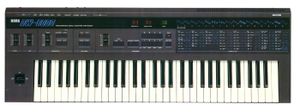
| Notes | One of the first Korg synths to use sampled digital waveforms instead of VCOs or DCOs, the DW-8000 puts its 512k of wave memory through warm analog filters and built-in digital delay. Programming is done via numeric parameters and/or a data slider and 2-character LED display; thankfully they're all printed on the case. You can get surprisingly rich sounds from it, and with an external controller like a BCR-2000 or Novation ReMOTE you can tweak the sounds as easily as an analog. A predecessor to the million-selling M1 rompler and the Wavestation. A rackmount version, the EX-8000, was also available.
Units you will encounter these days are about 30 years old. The most common repair needed is to replace the soldered-on battery with a battery holder; then, it's mechanical parts such as the mod/pitch joystick, tact switches and keybed aftertouch sensors among others. Its headphone output can be dangerously loud, so to avoid this, run the main outputs through a mixer or your computer audio interface so you can monitor it at controllable levels. |