

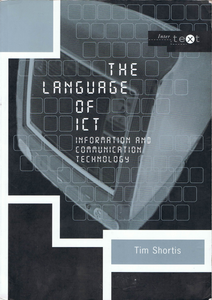

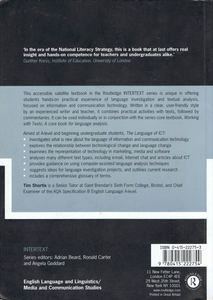
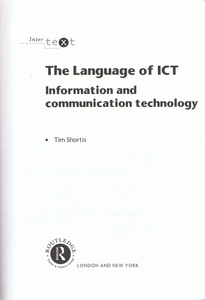
| Author | Tim Shortis |
| Publisher Series | Routledge INTERTEXT |
| Series Editor | Adrian Beard, Ronald Carter, Angela Goddard |
| First Published by | Routledge |
| Publisher | Routledge |
| Copyright Holder | Tim Shortis |
| Typeset by | Solidus (Bristol) Limited |
| Printed and Bound by | TJ International Ltd |
| Format | Paperback |
| Language | English |
| Location | United Kingdom |
| Copyright | 2001 |
| Pages / Font | 116 pages / Stone Sans/Stone Serif |
| ISBN 10 | 0-415-22275-3 |
| Barcode | 9 780415 222754 |
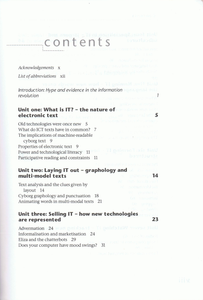
| Chapters | Acknowledgements
List of abbreviations
Introduction: Hype and evidence in the information revolution
UNIT ONE: WHAT IS IT? - THE NATURE OF ELECTRONIC TEXT
Old technologies were once new
What do ICT texts have in common?
The implications of machine-readable cyborg text
Properties of electronic text
Power and technological literacy
Participative reading and constraints
UNIT TWO: LAYING IT OUT - GRAPHOLOGY AND MULTI-MODEL TEXTS
Text analysis and the clues given by layout
Cyborg graphology and punctuation
Animating words in multi-modal texts
UNIT THREE: SELLING IT - HOW NEW TECHNOLOGIES ARE REPRESENTED
Advermation
Informalisation and marketisation
Eliza and the chatterbots
Does your computer have mood swings?
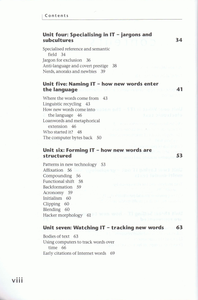
UNIT FOUR: SPECIALISING IN IT - JARGONS AND SUBCULTURES
SPECIALISED REFERENCE AND SEMANTIC FIELD
JARGON FOR EXCLUSION
ANTI-LANGUAGE AND COVERT PRESTIGE
NERDS, ANORAKS AND NEWBIES
UNIT FIVE: NAMING IT - HOW NEW WORDS ENTER THE LANGUAGE
Where the words come from
Linguistic recycling
How new words come into the language
Loanwords and metaphorical extension
Who started it?
The computer bytes back
UNIT SIX: FORMING IT - HOW NEW WORDS ARE STRUCTURED
Patterns in new technology
Affixation
Compounding
Functional shift
Backformation
Acronomy
Initialism
Clipping
Blending
Hacker morphology
UNIT SEVEN: WATCHING IT - TRACKING NEW WORDS
Bodies of text
Using computers to track words over time
Early citations of Internet words
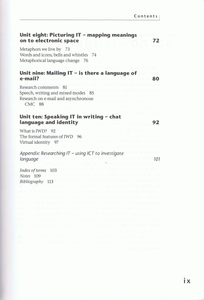
UNIT EIGHT: PICTURING IT - MAPPING MEANINGS ON TO ELECTRONIC SPACE
Metaphors we live by
Words and icons, bells and whistles
Metaphorical language change
UNIT NINE: MAILING IT - IS THERE A LANGUAGE OF E-MAIL?
Research commens
Speech, writing and mixed modes
Research on e-mail and asynchronous CMC
UNIT TEN: SPEAKING IT IN WRITING - CHAT LANGUAGE AND IDENTITY
What is IWD?
The formal features of IWD
Virtual identity
Appendix: Researching IT - using ICT to investigate language
Index of terms
Notes
Bibliography Acknowledgements
List of abbreviations
Introduction: Hype and evidence in the information revolution
UNIT ONE: WHAT IS IT? - THE NATURE OF ELECTRONIC TEXT
Old technologies were once new
What do ICT texts have in common?
The implications of machine-readable cyborg text
Properties of electronic text
Power and technological literacy
Participative reading and constraints
UNIT TWO: LAYING IT OUT - GRAPHOLOGY AND MULTI-MODEL TEXTS
Text analysis and the clues given by layout
Cyborg graphology and punctuation
Animating words in multi-modal texts
UNIT THREE: SELLING IT - HOW NEW TECHNOLOGIES ARE REPRESENTED
Advermation
Informalisation and marketisation
Eliza and the chatterbots
Does your computer have mood swings?
UNIT FOUR: SPECIALISING IN IT - JARGONS AND SUBCULTURES
SPECIALISED REFERENCE AND SEMANTIC FIELD
JARGON FOR EXCLUSION
ANTI-LANGUAGE AND COVERT PRESTIGE
NERDS, ANORAKS AND NEWBIES
UNIT FIVE: NAMING IT - HOW NEW WORDS ENTER THE LANGUAGE
Where the words come from
Linguistic recycling
How new words come into the language
Loanwords and metaphorical extension
Who started it?
The computer bytes back
UNIT SIX: FORMING IT - HOW NEW WORDS ARE STRUCTURED
Patterns in new technology
Affixation
Compounding
Functional shift
Backformation
Acronomy
Initialism
Clipping
Blending
Hacker morphology
UNIT SEVEN: WATCHING IT - TRACKING NEW WORDS
Bodies of text
Using computers to track words over time
Early citations of Internet words
UNIT EIGHT: PICTURING IT - MAPPING MEANINGS ON TO ELECTRONIC SPACE
Metaphors we live by
Words and icons, bells and whistles
Metaphorical language change
UNIT NINE: MAILING IT - IS THERE A LANGUAGE OF E-MAIL?
Research commens
Speech, writing and mixed modes
Research on e-mail and asynchronous CMC
UNIT TEN: SPEAKING IT IN WRITING - CHAT LANGUAGE AND IDENTITY
What is IWD?
The formal features of IWD
Virtual identity
Appendix: Researching IT - using ICT to investigate language
Index of terms
Notes
Bibliography Show all ▾ |
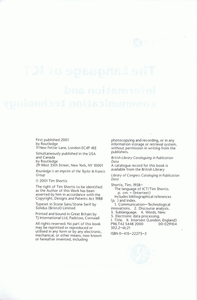
| Notes | Printed and bound in Great Britain First published 2001 by Routledge Simultaneously published in the USA and Canada by Routledge |
Added by Neotrinston