


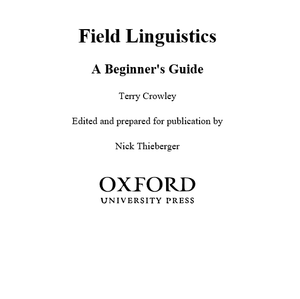
Field Linguistics: A Beginner's Guide
| Book | Field Linguistics: A Beginner's Guide |
| Format | e-Book |
| Language | English |
| Copyright | 2007 |
Collection
Read
| Author | Terry Crowley |
| About/Subject | Field Linguistics |
| Publisher Series | Oxford Linguistics |
| Editor | Nick Thieberger |
| Publisher | Oxford University Press |
| Copyright Holder | The Estate of the Late Professor Terry Crowley |
| Format | e-Book |
| Language | English |
| Location | Oxford; New York |
| Copyright | 2007 |
| Chapters | Preface
Acknowledgements
Editor's Foreword
Publisher's Note
1 FIELD LINGUISTICS: WHY BOTHER?
1.1 The threat to diversity
1.1.1 Some lessons from Truganini
1.1.2 The value of records
1.1.3 Diversity still undocumented
1.2 The 'Big Questions'
1.2.1 Armchairs and dirty feet
1.2.2 Fieldwork at home and fieldwork in The Field
1.3 What kind of linguistics?
1.4 Anthropological and linguistic fieldwork
2 ETHICAL ISSUES
2.1 Linguists and speakers
2.1.1 Ethical guidelines
2.1.2 Avoiding harm
2.1.3 Informed consent
2.1.4 Voluntary participation
2.1.5 Money and fieldwork
2.1.6 Ethical delinquency
2.2 Linguists and communities
2.2.1 Grammars
2.2.2 Dictionaries
2.2.3 Reading materials
2.2.4 Technical advice
2.2.5 Public awareness
2.2.6 Terminology development
2.2.7 Recognizing our limitations
2.3 Linguists and other linguists
3 GETTING STARTED
3.1 The fieldworker
3.2 Choosing a language
3.3. Background work
3.3.1 Reading the literature
3.3.2 The linguist and the lingua franca
3.4 Planning your fieldtrip
3.4.1 Fieldwork duration
3.4.2 Planning for contingencies
3.5 Funding
3.6 Permits
3.7 Equipment and supplies
3.7.1 Recording gear
3.7.2 Other needs
3.8 Getting about in the field
3.9 First contact
3.9.1 Arriving with an invitation
3.9.1 Arriving without an invitiation
3.9.3 Local reactions to the fieldworker
4 GATHERING YOUR DATA
4.1 Choosing language-helpers
4.1.1 'Informants'
4.1.2 Language-helpers at home
4.1.3 Language-helpers in the field
4.2 Phonological and grammatical elicitation
4.2.1 Language of elicitation
4.2.2 Working environment
4.2.3 Initial elicitation
4.2.4 Eliciting grammatical patterns
4.2.5 Taking notes
4.2.6 Native-speaker judgements
4.3 Gathering words
4.3.1 Direct elicitation
4.3.2 Beyond elicitation
4.3.3 Spontaneous speech
4.3.4 Sound substitutions
4.3.5 When is the dictionary done?
4.4 Keeping track of data
4.4.1 Daily records
4.4.2 Filing system
4.4.3 Computer storage
4.5 Archiving
5 BEYOND ELICITATION
5.1 The textual corpus
5.1.1 Early corpora
5.1.2 The recording of speech
5.1.3 What to record
5.1.4 Reasons for recording
5.1.5 How large a corpus?
5.1.6 Different genres
5.2 Getting it right
5.2.1 Evolving analyses
5.2.2 Native-speaker error
5.2.3 Fieldworker error
5.2.4 The problem of tunnel vision
5.3 Text transcription
5.4 Participant observation
5.4.1 Extracting and observing language
5.4.2 Overhearing in the field
5.4.3 Beyond linguistics
6 PROBLEMS AND PITFALLS
6.1 Analysis in the field
6.2 Learning to speak the language
6.2.1 Reasons for trying
6.2.2 Reasons for success and failure
6.2.3 Individual differences
6.3 Going troppo
6.4 Getting caught up
6.4.1 Becoming part of the scene
6.4.2 Unexpected entanglements
6.5 Linguists behaving badly
7 SALVAGE FIELDWORK
7.1 Getting started
7.1.1. Responding to the enthusiastic
7.1.2 Persuading the reluctant
7.2 Working with a limited number of speakers
7.2.1 Diminishing speaker populations
7.2.2 Diminishing structures
7.3 Legitimate linguistic authority
7.4 Saving the language?
References
Index
Preface
Acknowledgements
Editor's Foreword
Publisher's Note
1 FIELD LINGUISTICS: WHY BOTHER?
1.1 The threat to diversity
1.1.1 Some lessons from Truganini
1.1.2 The value of records
1.1.3 Diversity still undocumented
1.2 The 'Big Questions'
1.2.1 Armchairs and dirty feet
1.2.2 Fieldwork at home and fieldwork in The Field
1.3 What kind of linguistics?
1.4 Anthropological and linguistic fieldwork
2 ETHICAL ISSUES
2.1 Linguists and speakers
2.1.1 Ethical guidelines
2.1.2 Avoiding harm
2.1.3 Informed consent
2.1.4 Voluntary participation
2.1.5 Money and fieldwork
2.1.6 Ethical delinquency
2.2 Linguists and communities
2.2.1 Grammars
2.2.2 Dictionaries
2.2.3 Reading materials
2.2.4 Technical advice
2.2.5 Public awareness
2.2.6 Terminology development
2.2.7 Recognizing our limitations
2.3 Linguists and other linguists
3 GETTING STARTED
3.1 The fieldworker
3.2 Choosing a language
3.3. Background work
3.3.1 Reading the literature
3.3.2 The linguist and the lingua franca
3.4 Planning your fieldtrip
3.4.1 Fieldwork duration
3.4.2 Planning for contingencies
3.5 Funding
3.6 Permits
3.7 Equipment and supplies
3.7.1 Recording gear
3.7.2 Other needs
3.8 Getting about in the field
3.9 First contact
3.9.1 Arriving with an invitation
3.9.1 Arriving without an invitiation
3.9.3 Local reactions to the fieldworker
4 GATHERING YOUR DATA
4.1 Choosing language-helpers
4.1.1 'Informants'
4.1.2 Language-helpers at home
4.1.3 Language-helpers in the field
4.2 Phonological and grammatical elicitation
4.2.1 Language of elicitation
4.2.2 Working environment
4.2.3 Initial elicitation
4.2.4 Eliciting grammatical patterns
4.2.5 Taking notes
4.2.6 Native-speaker judgements
4.3 Gathering words
4.3.1 Direct elicitation
4.3.2 Beyond elicitation
4.3.3 Spontaneous speech
4.3.4 Sound substitutions
4.3.5 When is the dictionary done?
4.4 Keeping track of data
4.4.1 Daily records
4.4.2 Filing system
4.4.3 Computer storage
4.5 Archiving
5 BEYOND ELICITATION
5.1 The textual corpus
5.1.1 Early corpora
5.1.2 The recording of speech
5.1.3 What to record
5.1.4 Reasons for recording
5.1.5 How large a corpus?
5.1.6 Different genres
5.2 Getting it right
5.2.1 Evolving analyses
5.2.2 Native-speaker error
5.2.3 Fieldworker error
5.2.4 The problem of tunnel vision
5.3 Text transcription
5.4 Participant observation
5.4.1 Extracting and observing language
5.4.2 Overhearing in the field
5.4.3 Beyond linguistics
6 PROBLEMS AND PITFALLS
6.1 Analysis in the field
6.2 Learning to speak the language
6.2.1 Reasons for trying
6.2.2 Reasons for success and failure
6.2.3 Individual differences
6.3 Going troppo
6.4 Getting caught up
6.4.1 Becoming part of the scene
6.4.2 Unexpected entanglements
6.5 Linguists behaving badly
7 SALVAGE FIELDWORK
7.1 Getting started
7.1.1. Responding to the enthusiastic
7.1.2 Persuading the reluctant
7.2 Working with a limited number of speakers
7.2.1 Diminishing speaker populations
7.2.2 Diminishing structures
7.3 Legitimate linguistic authority
7.4 Saving the language?
References
Index
Show all ▾ |
Added by auboisdormant