

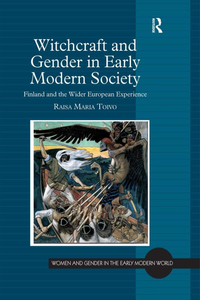
Witchcraft and Gender in Early Modern Society: Finland and the Wider European Experience
| Book | Witchcraft and Gender in Early Modern Society: Finland and the Wider European Experience |
| Format | e-Book |
| Language | English |
| Copyright | 2008 |
| Author | Raisa Maria Toivo |
| Imprint | Routledge |
| Publisher | Taylor & Francis Group |
| About/Subject | Witchcraft, Social conditions, Gender studies, Finland, Finnish history |
| Preface by | Raisa Maria Toivo |
| Publisher Series | Women and Gender in the Early Modern World |
| Format | e-Book |
| Language | English |
| Location | London and New York |
| Copyright | 2008 |
| Chapters | Cover Half
Title Title
Copyright
Contents
List of Figures and Table
List of Maps
Preface
1 Introduction
The state and power among the peasants
Witchcraft, witch trial sand authority
Women in and under authority
Court records as text
2 The Widow Farmer Witch: Agata Pekatytär 1670-1700
Agata Pekantytär, the mother
The widow cotter Inheritances 1671-1674
The plight of the heiress
Magic trials
The mother Agata Pekantytär, mistress of the farm
Farmhold responsibilities
Family haven?
Shared representation
Envious neighbours: witches to trial
The village
Agata Pekantytär as the reputed witch
Gossip
Old age
The story of a powerful woman?
3 Witches and Power
Poor or powerful people?
Women between kin and state
Power in court
Reading the court records
Witchcraft representing power
Conclusions
4 Work, Status and Power
Work as obedience
Work as personal worth
Witchcraft and skilled work
Work and community
Gendering work and witchcraft
Ownership and control
Partnership for power
Gendering work and power
Conclusions
5 Family, Women’s Status and Power
A woman's place
Spouses and protection
Exclusion from the family
Feminisms, witches and patriarchy
Regaining the body
Idealised mother and maternal power
Mother sand grandmothers
Conclusions
6 Conclusions: Mother, Wife and Witch
Women in court
Mothers, house wives
Witches
Appendix
Bibliography
Index Cover Half
Title Title
Copyright
Contents
List of Figures and Table
List of Maps
Preface
1 Introduction
The state and power among the peasants
Witchcraft, witch trial sand authority
Women in and under authority
Court records as text
2 The Widow Farmer Witch: Agata Pekatytär 1670-1700
Agata Pekantytär, the mother
The widow cotter Inheritances 1671-1674
The plight of the heiress
Magic trials
The mother Agata Pekantytär, mistress of the farm
Farmhold responsibilities
Family haven?
Shared representation
Envious neighbours: witches to trial
The village
Agata Pekantytär as the reputed witch
Gossip
Old age
The story of a powerful woman?
3 Witches and Power
Poor or powerful people?
Women between kin and state
Power in court
Reading the court records
Witchcraft representing power
Conclusions
4 Work, Status and Power
Work as obedience
Work as personal worth
Witchcraft and skilled work
Work and community
Gendering work and witchcraft
Ownership and control
Partnership for power
Gendering work and power
Conclusions
5 Family, Women’s Status and Power
A woman's place
Spouses and protection
Exclusion from the family
Feminisms, witches and patriarchy
Regaining the body
Idealised mother and maternal power
Mother sand grandmothers
Conclusions
6 Conclusions: Mother, Wife and Witch
Women in court
Mothers, house wives
Witches
Appendix
Bibliography
Index Show all ▾ |
| Notes | The title page misspells the author's last name as "Toiva". |
Added by auboisdormant